
April 28, 2026

If you ask the ultra-optimists, artificial intelligence (AI) technology will transform the economy on a scale comparable to the industrial revolution. And if that viewpoint turns out to be correct, the resulting productivity boom could mitigate many of the macro risks facing investors. But history suggests we may have reason for some caution.
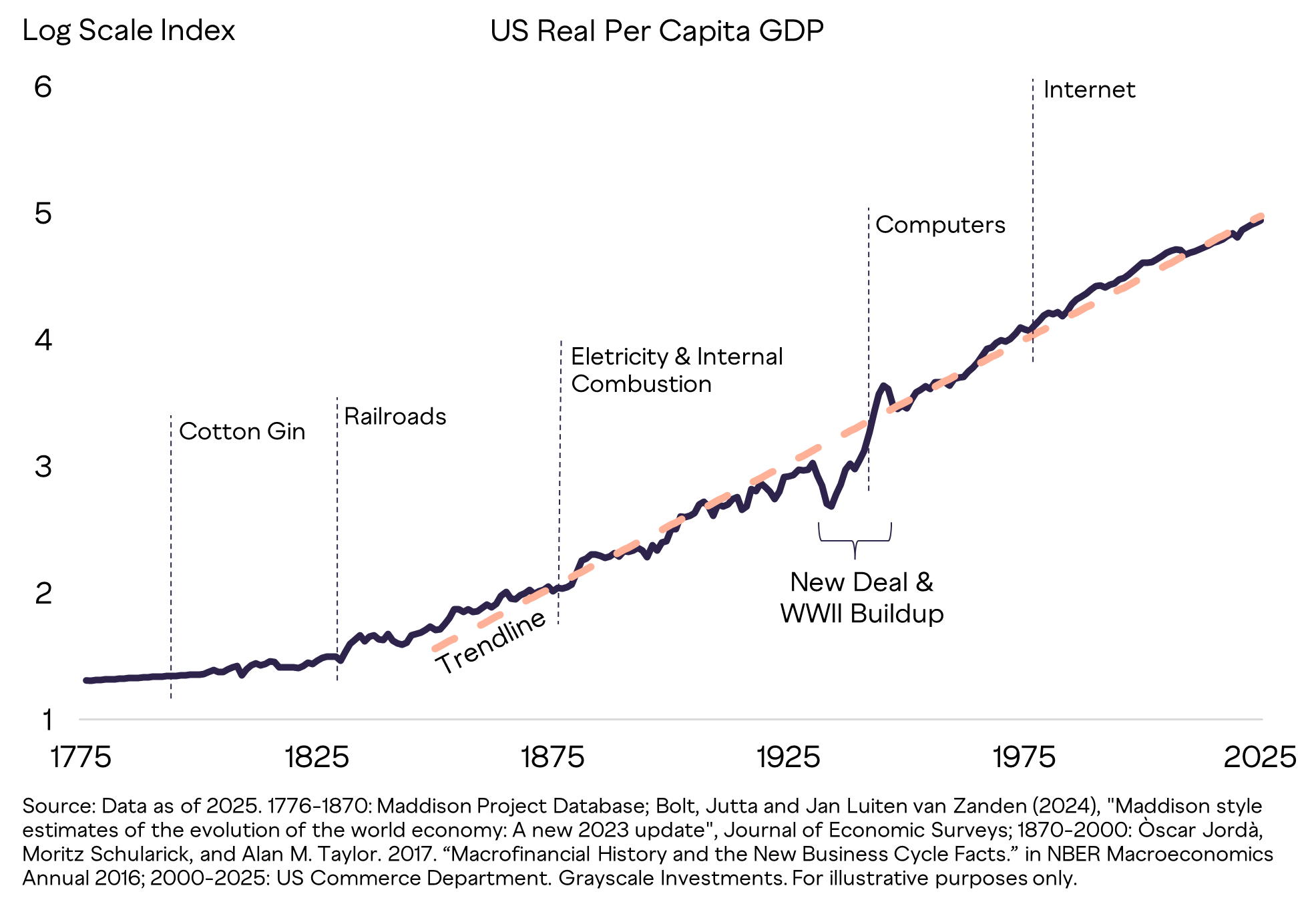
The chart below shows the history of US real per capita GDP (i.e., total output/income per person adjusted for inflation). The line starts to bend up in the middle of the 19th century—a phase we now call the industrial revolution. Since that time, living standards for successive generations have steadily improved. This is the miracle of modern society.
But the other remarkable fact about the history of productivity is that the pace of progress thereafter has been roughly linear. Per capita GDP has increased on average by 2% per annum for more than 150 years, with remarkably little variation (the Great Depression and World War II are the exceptions). A lot of major technological advancements have come along during that time, including electrification, the internal combustion engine, computers, and the internet. These achievements have prolonged the steady advance of economic productivity but have not resulted in an accelerating rate of growth.
AI could be different, but would you bet your portfolio on it? If the productivity gains from AI are “only” as good as the computer and internet, investors will need to grapple with the fact that equity multiples are already quite high, and that governments may need to inflate their way out of excessive debt. This would argue for portfolio diversification, especially into scarce assets like physical gold and Bitcoin.
Key Takeaway: If productivity gains from AI are “only” as good as computers and the internet, investors will still need to contend with major macro imbalances and could consider assets that provide diversification and scarcity.
Related
© 2026 Grayscale. All rights reserved
All data sourced from Bloomberg as of the date of publication, unless otherwise noted.
Investments in digital assets are speculative investments that involve significant risk, including a partial or total loss of invested funds. Investments in digital assets are not suitable for any investor that cannot afford loss of the entire investment.
This information should not be relied upon as research, legal, tax or investment advice, or a recommendation regarding any products, strategies, or any investment in particular. This material is strictly for illustrative, educational, or informational purposes and is subject to change. This content does not constitute an offer to sell or the solicitation of an offer to sell or buy any security in any jurisdiction where such an offer or solicitation would be illegal. There is not enough information contained in this content to make an investment decision and any information contained herein should not be used as a basis for this purpose. Readers are encouraged to seek guidance from qualified professionals.
Index returns are presented for illustrative purposes only and exclude management fees and expenses. Indexes are unmanaged, and investors cannot invest directly in an index. A basis point (bps) is one hundredth of one percent (e.g. one basis point = 0.01%).
Grayscale Operating, LLC and its affiliates, directors, officers, and employees may have interests, financial or otherwise, in the digital assets and/or securities discussed.
Certain of the statements contained herein may be statements of future expectations and other forward-looking statements that are based on Grayscale’s views and assumptions and involve known and unknown risks and uncertainties that could cause actual results, performance, or events to differ materially from those expressed or implied in such statements. In addition to statements that are forward-looking by reason of context, the words “may, will, should, could, can, expects, plans, intends, anticipates, believes, estimates, predicts, potential, projected, or continue” and similar expressions identify forward-looking statements. Grayscale assumes no obligation to update any forward-looking statements contained herein and you should not place undue reliance on such statements, which speak only as of the date hereof. Although Grayscale has taken reasonable care to ensure that the information contained herein is accurate, no representation or warranty (including liability towards third parties), expressed or implied, is made by Grayscale as to its accuracy, reliability, or completeness. You should not make any investment decisions based on these estimates and forward-looking statements.
Specific companies, issuers, platforms, or protocols are mentioned for educational purposes only and should not be deemed a recommendation to buy or sell any securities, digital assets, or other financial instruments. Any entities mentioned do not necessarily represent current or future holdings of any Grayscale products.
All content is original and has been researched and produced by Grayscale Investments Sponsors, LLC (“Grayscale”) unless otherwise stated herein. No part of this content may be reproduced in any form, or referred to in any other publication, without the express consent of Grayscale.
© 2026 Grayscale. All trademarks, service marks and/or trade names (e.g., G™, GRAYSCALE®, GRAYSCALE CRYPTO SECTORS™, and GRAYSCALE INVESTMENTS®) are owned and/or registered by Grayscale.