Business Organizations: What is a DAO Legally, Anyways?

Jason Civalleri
Last Update 5/17/2023 | 15 min. read
As the popularity of blockchain technologies expands, so does the base of investors who buy, sell, and own crypto-assets. We believe the concept of Decentralized Autonomous Organizations – or “DAOs” – is an exciting and promising feature of blockchain technology. In this novel business structure, token-holders use smart contracts to collectively manage on-chain activities, upgrades, and treasuries. In other words, DAOs govern various blockchain protocols, and the DAO tokens allow holders to “vote” on corresponding decisions brought about by the DAO. Many feel that DAOs are revolutionary because they are administered by technology, not via traditional contract or law.
One differentiator between DAOs and traditional business structures (such as corporations or limited liability companies) is that DAOs are created by “registering” via smart contracts using blockchain technologies, and not by registering with a state authority or by fulfilling certain legal requirements. Purchasing DAO tokens can therefore carry significant legal risk of liability. The existence of DAOs before legal recognition is unique – typically new business structures are created by legal development, not independent of it.
This lack of legal development raises some important questions about DAOs. If they are not formally recognized business structures, can DAOs open a bank account or own intellectual property? Do DAOs have standing to sue or be sued? If so, how can a party effectively serve a legal process (or notice of initial legal action to another party) on a DAO?
This piece attempts to explain DAOs, demystify some of the legal contours surrounding DAOs compared to traditional businesses, and outline the risks of directly owning crypto-assets.
What are DAOs?
DAOs are emerging organizational structures that have no central governing body and whose activities are collectively controlled by its members intending to act in the best interests of the organization. Members join DAOs by purchasing its related tokens, which may be used to vote on the DAO’s governance and decision-making. Because DAO votes and activities are published on a public blockchain, any DAO actions are freely viewable. A DAO can oversee the activities of an on-chain protocol or could simply be a group of people who have joined together towards a common interest, like fostering a community around a media franchise or raising funds and support for a war effort, that use blockchain to coordinate.
DAOs have increasingly permeated the blockchain ecosystem. For example, Decentraland is a blockchain-powered metaverse game completely governed by a DAO. Holders of Decentraland tokens and units of in-game land (known as “LAND”) can vote to change the gameplay, add new in-game items, and even designate certain LANDs as “Points of Interest” that have special importance to the Decentraland community. In another example, Synthetix is a derivatives liquidity protocol that allows users to create “synthetic assets,” or crypto-assets whose value track that of other assets without the need of a centralized authority or intermediary. Control of Synthetix is delegated among multiple DAOs, with token-holders voting on representatives authorized to engage in activities that range from deciding which synthetic assets should be issuable on the protocol to dispersing grants from the Synthetix treasury. In a third example, the less protocol-oriented DAO, ConstitutionDAO, was a DAO formed with the purpose of raising money to bid on purchasing an original copy of the United States Constitution. While ConstitutionDAO failed to succeed in its bid, it was an excellent case study of a community coming together on the blockchain to achieve a common goal, and presumably the DAO would have been charged with managing the real-life historical object were it successful.
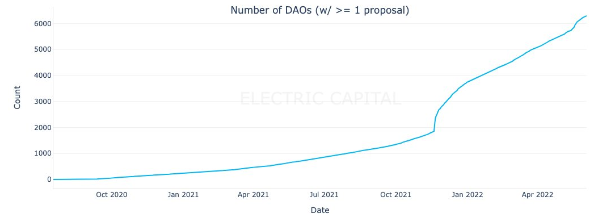
DAOs can be a powerful and versatile tool in organizing group coordination and their full potential is still being explored. The number of DAOs and governance proposals put to DAO-vote are rapidly increasing, indicating that this is a popular new style of business and community coordination. But if DAOs are developed independently of legal concepts, how might the law view these technologically-linked groups of decision-makers?
Source: Electric Capital
Business Associations
Business associations are legal concepts that legally represent a group or organization and its activities. Business associations can engage in many of the legal rights and responsibilities that natural people carry, such as entering into transactions, opening a bank account, paying taxes, owning property, and suing or being sued.
There are different types of business associations, each with their own requirements and characteristics. Corporations and limited liability companies (“LLCs”) are well-known business entities under which businesses and non-profits often operate. Among other requirements, corporations and LLCs both require filing certain charter documents with a state government that describe the entity’s governance structure, designate a method to serve process against the entity, and name certain persons charged with administering the organization. Importantly, both corporations and LLCs carry “limited liability,” meaning that (subject to certain exceptions) owners of the entity themselves are shielded from personal legal liability for the entity’s activities. This is why shareholders in a corporation do not have to worry about their personal assets being forfeited in the event the corporation is sued.
If a business organization does not file the requisite documentation with a state and does not meet qualifications to form as another type of organization, it will generally be classified as a default type of association such as an unincorporated association. Unlike corporations and LLCs, unincorporated associations do not generally carry limited liability to protect their members from being personally liable for the organization’s activities. Further, members of certain unincorporated associations (such as a general partnership) are considered “jointly and severally liable” for any damages that the association may cause, meaning that each member is on the hook for the full amount of damages caused by the association even if they did not personally contribute to the harm. For example, each member of a three-person general partnership that caused a million dollars of damages will be individually and personally liable for the full million dollars until the damages are repaid, even if only one of the members actually caused the harm.
Business organizations are a bedrock legal concept that help facilitate the occurrence of modern, first world in a smooth and efficient manner.
Are DAOs Unincorporated Associations?
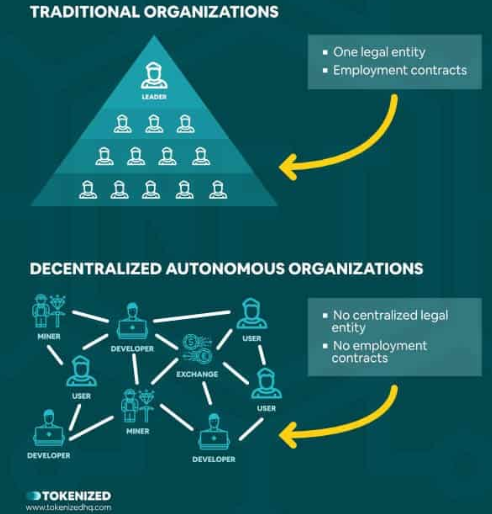
A DAO’s decentralized nature makes it ill-fit to file as a corporation or LLC. For example, DAOs tend to form without formalized leadership structures and it is often unclear who should act as administrative lead for filing purposes. Further, given that DAO membership tends to be driven by token-holders – tokens which are tracked on a pseudonymous blockchain and typically transact in a highly liquid environment – it may be difficult to draft corporate documents that properly reflect the ownership structure. And, philosophically, if a DAO’s entity status is granted (and revocable) by a centralized authority like a state, is it truly decentralized and autonomous?
Source: Tokenized
While it may be difficult to overcome these hurdles to form an LLC or corporate structure that adequately protects a DAO without sacrificing some of the benefits represented by the new technology, the alternative is that a DAO may be considered the default unincorporated association for the purposes of assigning liability in the event a DAO causes harm. This means that if the entire class of DAO token-holders is considered owners of a particular DAO, all of the token-holders will be considered jointly and severally liable for any harms created by that DAO – even if a particular owner only owned a fraction of a token at the time the harm was incurred. The upshot is that the mere purchasing and holding of DAO tokens may carry a risk of substantial liability for any of the DAO’s activities.
Two recent court decisions appear to confirm this concept, and both involve the same two DAOs, bZx DAO, and its successor, Ooki DAO. bZx DAO provided a blockchain-based decentralized margin trading and lending protocol until it was hacked for approximately $55 million worth of tokens in 2019. As the community around the DAO attempted to recover after the hack, Ooki DAO was launched with similar functionality to serve as a successor to bZx DAO. A group of individual users of the platform that were harmed in the hack filed a class action lawsuit against bZx DAO (the “bZx suit”). Meanwhile, the Commodities Futures Trading Commission (CFTC) attempted to sue Ooki DAO for operating an unregistered derivatives exchange in violation of the Commodities Exchange Act (the “Ooki suit”). Both cases involved the question of whether the relevant DAO constituted a business organization that could be sued.
Case #1: bZx Dao
In the bZx suit, the United States District Court of the Southern District of California looked to the California definition of general partnership of an “(1) association of two or more persons (2) carrying on as co-owners of (3) a business for profit.” The court noted both that the DAO was properly alleged to involve an association of two or more persons, and that the bZx platform generated profits through its margin trading and lending products. In determining whether those individuals carried on as co-owners of the DAO, the court determined that the plaintiffs properly alleged that “bZx DAO is controlled by those who hold the BZRX token,” and that those token-holders had governance rights in the DAO. Specifically, the plaintiffs alleged that token-holders can suggest and vote on governance proposals, including “spending treasury funds to hire people; changing organizational goals and policies; and even distributing treasury assets to token-holders, like how corporations can authorize dividends.” Given that token-holders could contribute to these management decisions and shared profits and losses (such as treasury asset distributions), the court found the plaintiffs successfully alleged that bZx DAO constitutes a general partnership – meaning that anyone holding a token is considered a partner for the purposes of the DAO’s liability.
Case #2: Ooki DAO
In the Ooki suit, the United States District Court of the Northern District of California arrived at a similar conclusion when considering whether Ooki DAO comprised an organization that could be served process in a lawsuit. The court examined whether Ooki DAO comprised an unincorporated association for the purposes of serving process, noting that California state law defines an unincorporated association as “an unincorporated group of two or more persons joined by mutual consent for common lawful purpose.” The court determined that because the DAO was comprised of multiple token-holders, it may be considered “two or more persons.” The court then found that token-holders “joined by mutual consent” by obtaining the tokens and understanding the inherent power that comes with holding tokens – and decided that running a derivatives exchange in itself is not inherently unlawful.
The court found that token-holders joined for a “common lawful purpose,” and therefore Ooki DAO constituted an unincorporated association for the purpose of serving process. The court noted that “individuals who own but do not vote their token still comprise the DAO because the purpose of holding a token is being able to vote on the DAO’s governance,” potentially implying that any token-holder may be liable for harms caused by the DAO.
Implications for Token Owners
Regulators in the US and around the world have taken note of issues related to the lack of a convenient legal wrapper for DAOs, and certain regulators have begun experimenting with solutions to help protect DAO users embracing this technological innovation. For example, both the state of Wyoming and the Republic of Marshall Islands have developed “DAO LLC” legal structures, which are designed to help DAOs protect themselves and their members. However, adoption has been relatively slow so far, as each of the laws comes with pitfalls that give DAO members pause for concern.
As such, unincorporated DAOs continue to be common. While both the bZx suit and the Ooki suit focused on the organization-status of DAOs to be named in a legal complaint, the specter of joint and several liability looms for anyone who owns tokens in such a DAO. Investors should be mindful that unlike owning stock in a corporation, there may be hidden personal risks to holding DAO tokens. Fortunately, investors in Grayscale products are shielded from the personal risk of investing in DAO tokens through the Grayscale products’ legal structure. That means investors can gain exposure to DAO assets, like Decentraland, through Grayscale products in the form of a familiar security. This removes not only the challenges of buying, storing, and safekeeping digital assets directly, but also protects investors from personal liability risk should something go wrong.