October 21, 2026

Bitcoin is a digital commodity and a decentralized alternative to fiat currencies. It is often described as “digital gold” and, in our view, should be valued that way. But many other crypto assets can be valued with cash flows. At Grayscale, we believe that rigorous fundamental valuation will play a defining role in the next chapter of digital asset investing.
Onchain applications typically operate identifiable business models, generating fees from trading, lending, and other financial activities. After paying out supply-side costs1, remaining earnings can be measured and compared across protocols. Much like traditional businesses, these economic fundamentals provide a foundation for determining digital asset valuations.
Crypto protocols also have several mechanisms for returning value to tokenholders. Buybacks reduce circulating supply, token burns permanently reduce total supply, and staking distributions reward tokenholders directly.
At the same time, new token issuance and unlocks can offset these benefits through dilution. Understanding the relationship between capital returns and token supply is therefore critical to evaluating the economic value accruing to each token.
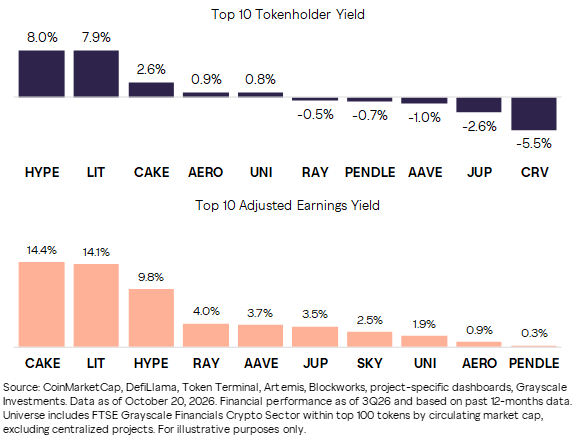
Grayscale Research evaluates tokenholder economics through measures such as Tokenholder Yield2, which captures distributions to tokenholders less supply inflation, and Adjusted Earnings Yield3, which measures protocol earnings relative to market capitalization after adjusting for inflation. Together, these metrics can offer a more complete picture of how onchain protocols generate economic value and how much of that value may ultimately accrue to tokenholders.
Key Takeaway: Crypto valuations don't have to rely on narratives alone. Onchain applications generate measurable economic value through earnings and capital returns, providing investors with a foundation for fundamental valuation.
Exhibit 1: Tokenholder yield and adjusted earnings yield vary widely by protocol