
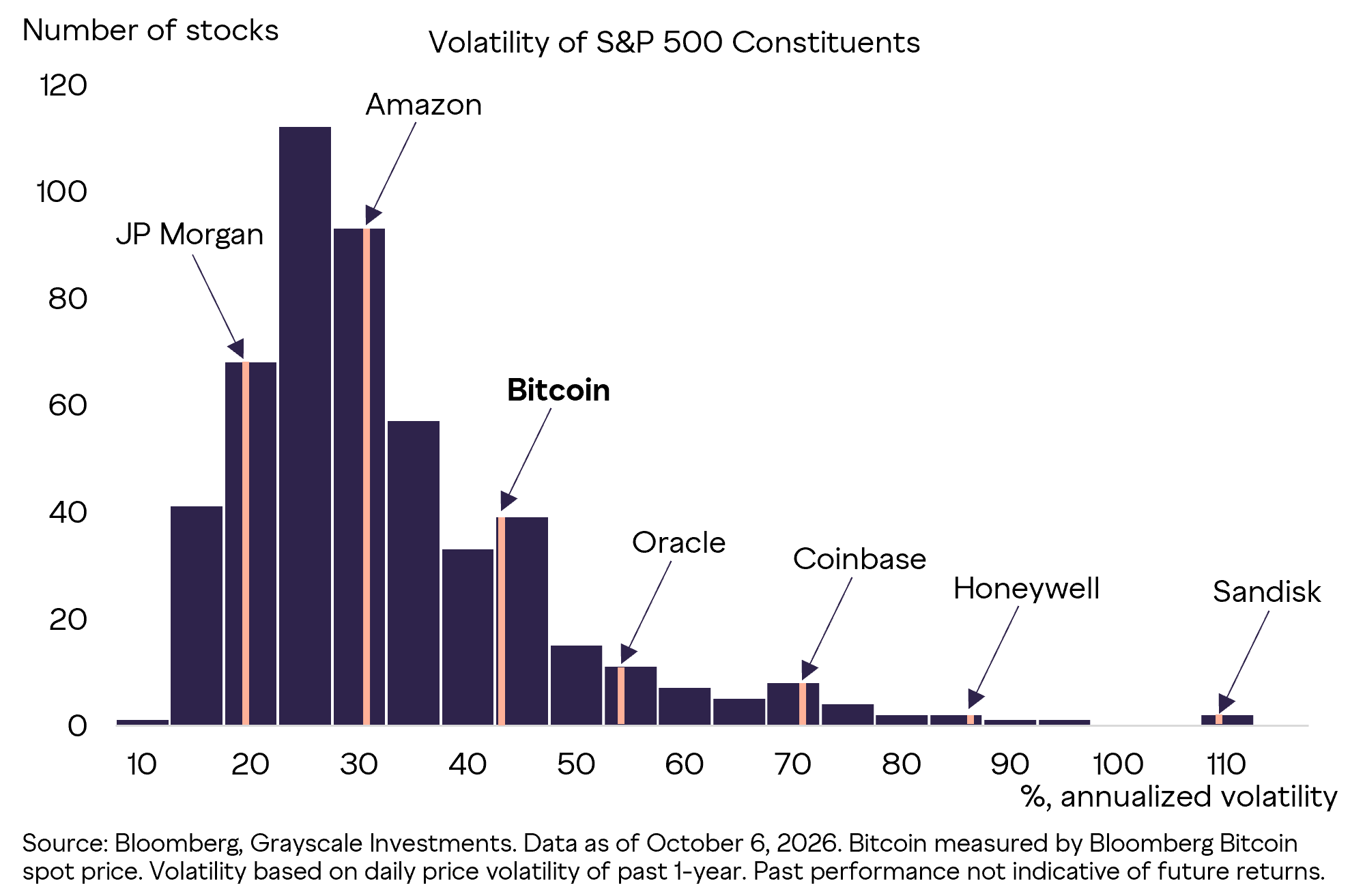
Bitcoin’s reputation for high volatility can make it seem far removed from traditional investments. But comparing its price fluctuations with those of US large-cap stocks offers an unexpected perspective. Over the past year, Bitcoin’s realized volatility fell within the distribution of S&P 500 constituents, with a meaningful number of large-cap stocks exhibiting far greater volatility (Exhibit 1). Bitcoin’s volatility has declined to 43% over the past year, from an average of 64% over the past 10 years and 81% five years ago. It is now lower than that of 19% of S&P 500 constituents.1
In fact, Bitcoin's volatility has come down meaningfully not just over the past year, but over the past decade. As the asset has matured, with deeper liquidity, broader institutional participation, and more regulated access venues, its price swings have narrowed considerably from the extremes of its early years. Its volatility today is above that of most stocks in this sample but in our view no longer sits in a separate category of risk.
That shifts the question from whether to own a volatile asset to how to size an allocation. Investors already manage volatile holdings by sizing positions to match their risk tolerance and by considering how each one behaves alongside the rest of the portfolio. The same tools apply to Bitcoin.
One year of data cannot establish Bitcoin’s risk across market cycles, but the comparison gives investors a concrete reference point. For those comfortable owning volatile equities, Bitcoin’s price fluctuations may be less daunting than assumed.
Key Takeaway: Bitcoin’s volatility has continued to trend lower2 and is now familiar territory for investors in individual stocks, particularly growth-oriented ones—and a potential investment warrants the same disciplined assessment of risk and opportunity.
Exhibit 1: Bitcoin's volatility has been well within the range of S&P 500 stocks
Related
© 2026 Grayscale. All rights reserved
All data sourced from Bloomberg as of the date of publication, unless otherwise noted.
Investments in digital assets are speculative investments that involve significant risk, including a partial or total loss of invested funds. Investments in digital assets are not suitable for any investor that cannot afford loss of the entire investment.
This information should not be relied upon as research, legal, tax or investment advice, or a recommendation regarding any products, strategies, or any investment in particular. This material is strictly for illustrative, educational, or informational purposes and is subject to change. This content does not constitute an offer to sell or the solicitation of an offer to sell or buy any security in any jurisdiction where such an offer or solicitation would be illegal. There is not enough information contained in this content to make an investment decision and any information contained herein should not be used as a basis for this purpose. Readers are encouraged to seek guidance from qualified professionals.
Index returns are presented for illustrative purposes only and exclude management fees and expenses. Indexes are unmanaged, and investors cannot invest directly in an index. A basis point (bps) is one hundredth of one percent (e.g. one basis point = 0.01%).
Grayscale Operating, LLC and its affiliates, directors, officers, and employees may have interests, financial or otherwise, in the digital assets and/or securities discussed.
Certain of the statements contained herein may be statements of future expectations and other forward-looking statements that are based on Grayscale’s views and assumptions and involve known and unknown risks and uncertainties that could cause actual results, performance, or events to differ materially from those expressed or implied in such statements. In addition to statements that are forward-looking by reason of context, the words “may, will, should, could, can, expects, plans, intends, anticipates, believes, estimates, predicts, potential, projected, or continue” and similar expressions identify forward-looking statements. Grayscale assumes no obligation to update any forward-looking statements contained herein and you should not place undue reliance on such statements, which speak only as of the date hereof. Although Grayscale has taken reasonable care to ensure that the information contained herein is accurate, no representation or warranty (including liability towards third parties), expressed or implied, is made by Grayscale as to its accuracy, reliability, or completeness. You should not make any investment decisions based on these estimates and forward-looking statements.
Specific companies, issuers, platforms, or protocols are mentioned for educational purposes only and should not be deemed a recommendation to buy or sell any securities, digital assets, or other financial instruments. Any entities mentioned do not necessarily represent current or future holdings of any Grayscale products.
All content is original and has been researched and produced by Grayscale Investments Sponsors, LLC (“Grayscale”) unless otherwise stated herein. No part of this content may be reproduced in any form, or referred to in any other publication, without the express consent of Grayscale.
© 2026 Grayscale. All trademarks, service marks and/or trade names (e.g., G™, GRAYSCALE®, GRAYSCALE CRYPTO SECTORS™, and GRAYSCALE INVESTMENTS®) are owned and/or registered by Grayscale.