
November 4, 2026

Bitcoin’s inclusion in J.P. Morgan Asset Management’s 2027 Long-Term Capital Market Assumptions1 marks another milestone in its evolution as an institutional asset. The $5 trillion investment manager now examines Bitcoin alongside established asset classes, forecasting a base-case compound annual return of 10% over the next decade alongside annualized volatility of 55%. These estimates bring Bitcoin’s potential rewards—and higher risks—into a familiar portfolio construction framework.
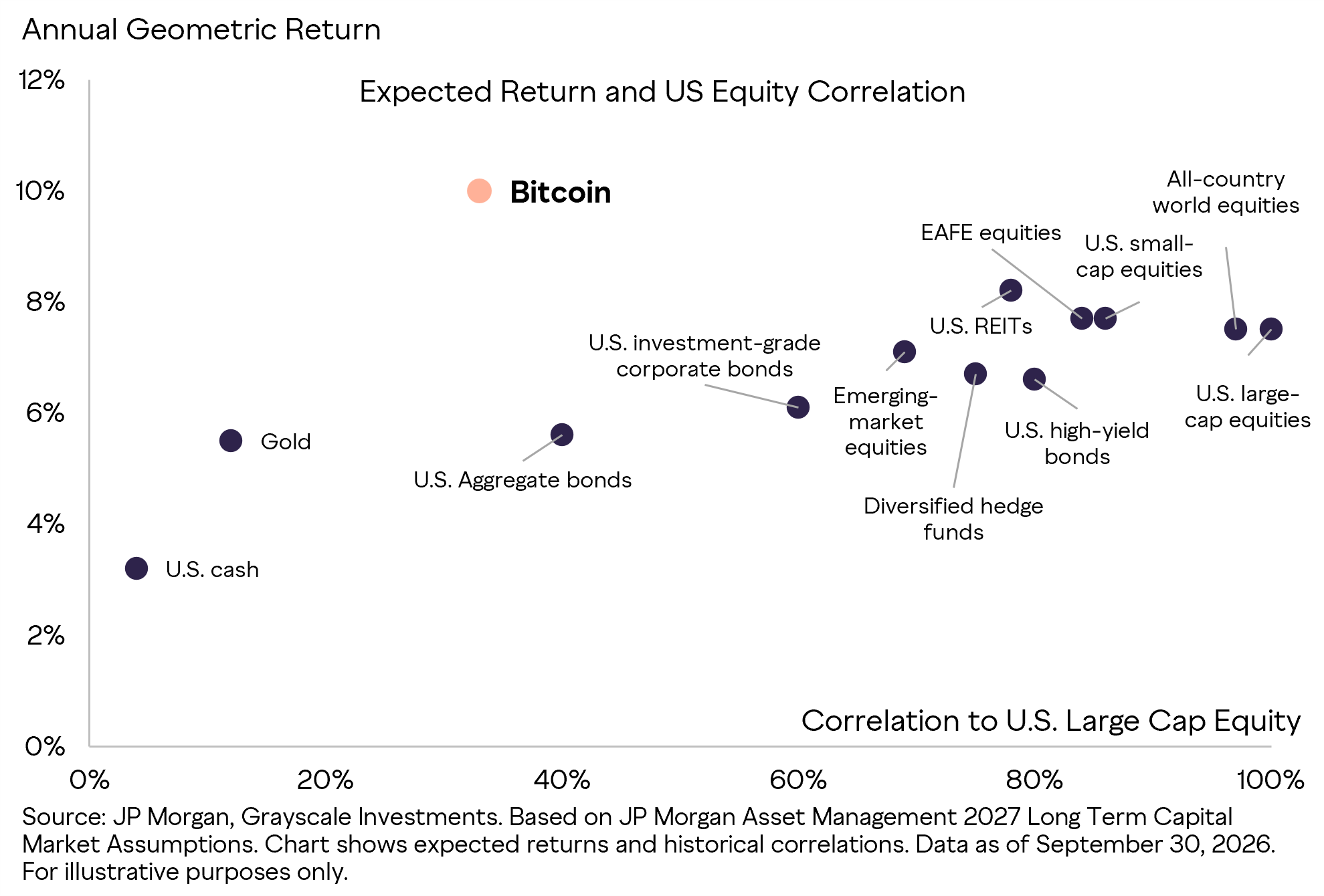
JPM’s assumptions highlight why Bitcoin deserves a closer look as a potential addition to traditional portfolios. Its projected 10% compound annual return exceeds estimated returns for all other asset classes, while its estimated correlation with US large cap stocks is just 33%—below international equities, corporate bonds, and hedge funds. Assets with high absolute returns and a low correlation to core equities are hard to find, and these features make Bitcoin a potentially attractive portfolio diversifier (Exhibit 1).
Bitcoin’s growing institutional recognition does not mean its portfolio role is settled. JPM remains cautious about unstable correlations and excludes Bitcoin from its main covariance matrices. Our analysis illustrates the potential portfolio benefits under the stated assumptions; the realization of those benefits will depend on how Bitcoin’s returns and relationships with other assets evolve.
Key Takeaway: Bitcoin’s inclusion in JPM’s long-term assumptions is another institutional milestone. Bitcoin’s relatively high expected returns and low correlations with large cap equities make it a potentially attractive portfolio diversifier.
Exhibit 1: Capital market assumptions set Bitcoin apart in return and correlation
The capital market assumptions summarized herein are sourced from third-party asset managers and are presented for informational and illustrative purposes only. Grayscale does not warrant their accuracy or completeness. These assumptions reflect each firm’s judgment based on current market conditions, are subject to change without notice, and are not promises or estimates of actual returns any portfolio may achieve. Nothing in this material constitutes investment, accounting, legal, or tax advice, or a recommendation to buy or sell any security, asset class, or strategy, and past performance is not a reliable indicator of future results.