November 3, 2026

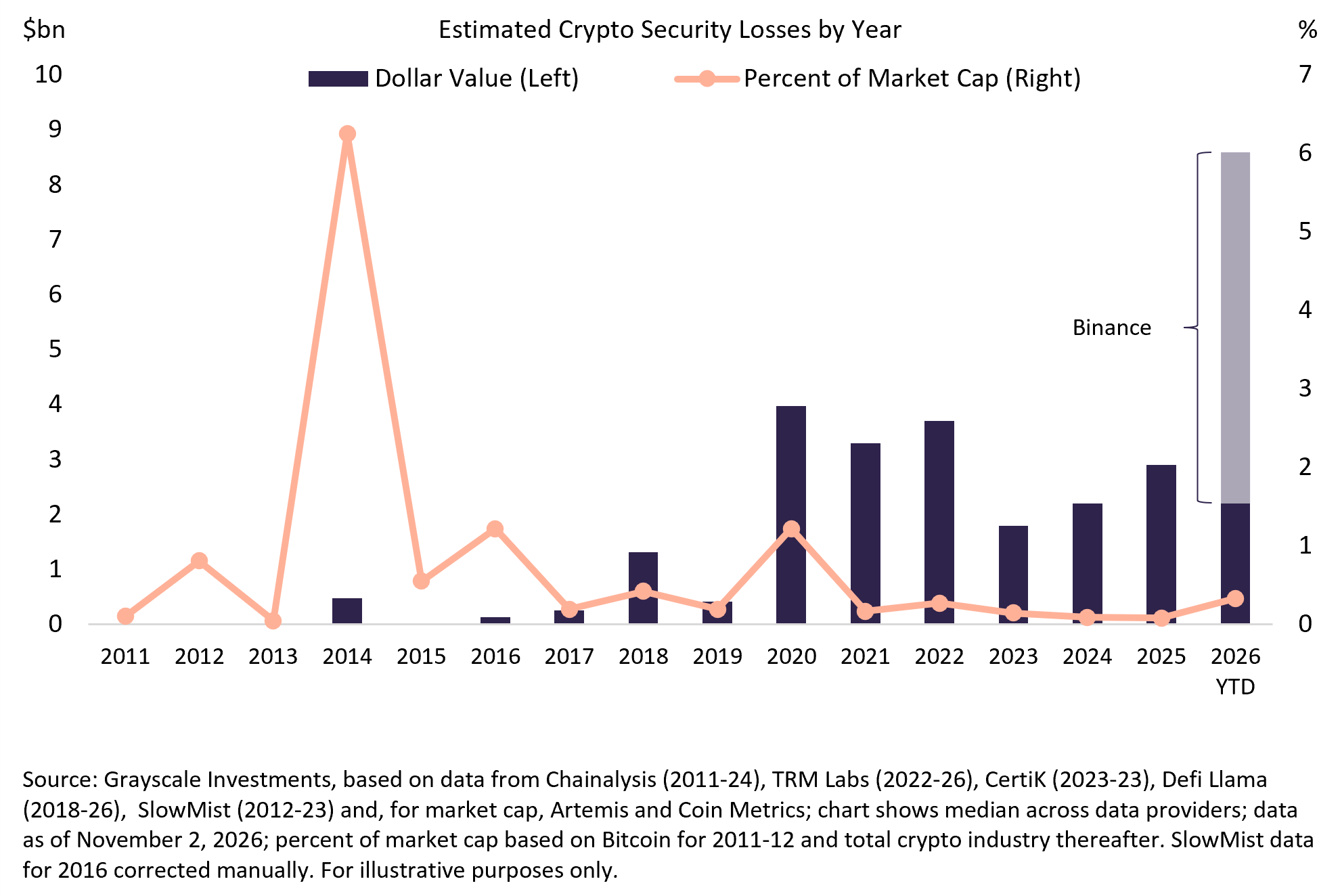
The hack on Binance drained more than $6 billion in assets from the world’s largest crypto exchange on Oct. 19.1 The cyber intrusion, attributed to North Korea,2 takes crypto security losses to a new high of more than $8 billion in 2026 (excluding it, however, makes losses so far in 2026 comparable to last year). More importantly, losses have declined significantly relative to total crypto market capitalization over time (Exhibit 1).3
Binance has been able to swiftly restore customer positions in the aftermath of the attack. The exchange said that 95% of the affected assets have, as of this writing, been fully covered (the remaining 5% of less liquid tokens will take longer to restore).4 In other words, Binance customers will bear none of the loss. Also, about $2.9 billion (~45%) of the stolen funds have been frozen by stablecoin issuers, including Tether and Circle. Issuers regularly work with law enforcement, and we can expect these funds to be returned to Binance.5
So what does this hack mean to US crypto investors?
First, while it may be a temporary setback for market confidence, we believe it will ultimately result in stronger security practices for all exchanges.
Second, we believe that it stresses the importance of institutional custody for crypto assets. In fact, a growing number of US-based investors have been using crypto exchange-traded products (ETPs)—which offer the convenience of institutional custody—to gain exposure to digital assets.
These vehicles typically include segregated holdings, offline storage, multi-signature wallets, strict internal processes, and insurance policies. For many crypto assets, investors can contribute tokens in-kind into US-listed ETPs, retaining their original cost basis while also seeking to upgrade security.
Key Takeaway: Unfortunate as it is, the Binance hack will, in our view, result in stronger security practices for exchanges going forward. It also underscores the importance of institutional custody, such as offered by US-based crypto ETPs. These vehicles hold their assets at state-charted banks and qualified custodians, typically offering offline storage, multi-signature wallets, SOC attestations, and insurance policies.
Exhibit 1: Crypto security losses have trended lower as a share of market cap