October 30, 2026

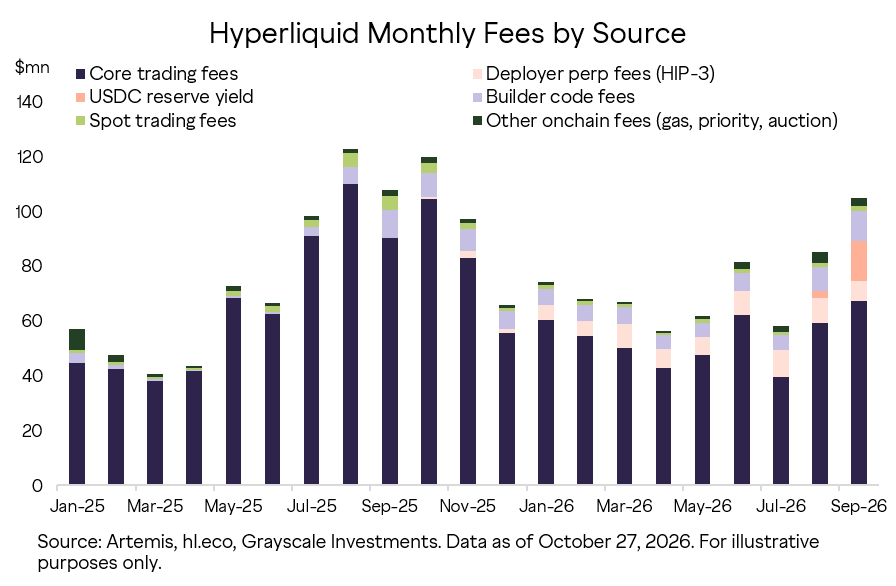
Hyperliquid, a decentralized exchange and innovative blockchain-based trading platform, generated about $105 million in revenue in September 2026. This is about the same as a year earlier ($108 million) despite the intervening crypto bear market.1 Hyperliquid revenue has remained strong partly because activity on the platform has become more diversified.
In mid-2025, core trading fees (from perpetual futures contracts on crypto assets listed by the Hyperliquid team) made up over 90% of revenue. Today they’re about 64% (Exhibit 1). The rest now comes from newer sources as Hyperliquid grows from an exchange into a broader financial platform. Specifically:
In our view, the mix matters as much as the total. Non-core revenue was $38 million in September, double what it was a year earlier. Reserve yield in particular depends on deposits and interest rates rather than trading volume, which makes it a steadier income stream.
Looking ahead, regulated access for US traders could be the next lever of growth. Kraken parent Payward intends to become the first CFTC-regulated deployer on HIP-3*, a version of HIP-3 that lets deployers restrict markets to approved, KYC’ed users, while ICE, owner of the New York Stock Exchange, has partnered with leading HIP-3 deployer Trade.xyz to build a US-regulated perpetual futures market on Hyperliquid infrastructure.2
Key Takeaway: Hyperliquid has diversified its revenue meaningfully over the past year. Roughly a third now comes from third-party markets, distribution partners, and stablecoin yield, making the protocol less dependent on the crypto perps it lists itself. Pending US-regulated deployments could open further avenues for growth.
Exhibit 1: Hyperliquid’s revenue is increasingly diversified