October 26, 2026

Zcash (ZEC), a Bitcoin-like digital currency with additional privacy features, turns 10 years old this week (on Oct 28). Zcash has continued to evolve over time, even through extended bear markets and periods when the price of ZEC lagged other cryptocurrencies. One important reason behind this continuous innovation has been the protocol’s consistent financial support for R&D.
On the Bitcoin blockchain, miners earn 100% of BTC rewards in each block. On the Zcash blockchain, in contrast, miners earn 80% of ZEC rewards. The remaining 20% is set aside for the Dev Fund, a pool of capital that supports Zcash development and related ecosystem initiatives.1 Most blockchains rely on venture capital or other private funding—Zcash is one of the few networks to build ecosystem funding directly into the protocol.
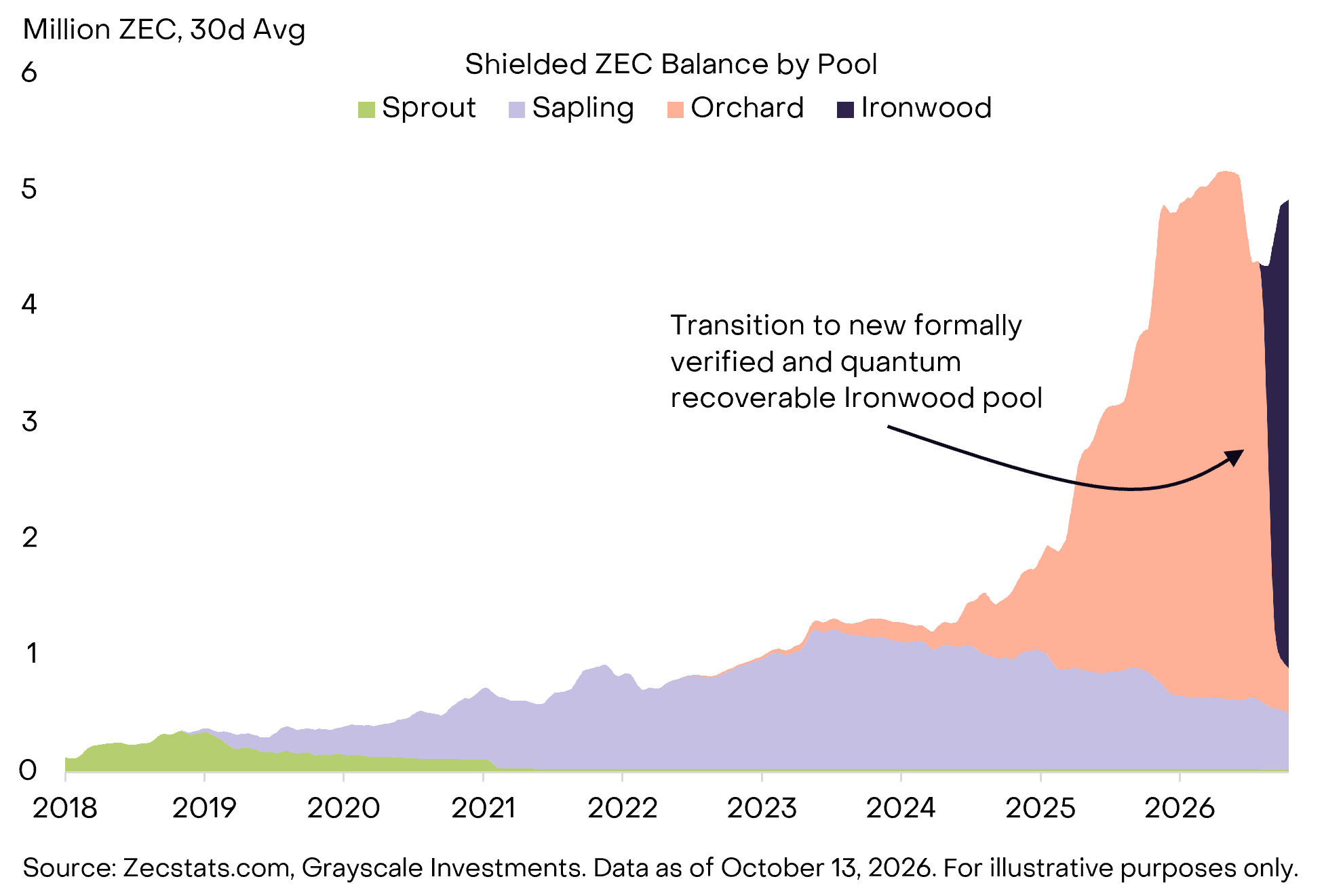
One clear example of Zcash’s culture of innovation has been the introduction of new privacy pools—the structure that gives Zcash its privacy features (Exhibit 1). The network launched with the Sprout pool, then introduced the Sapling and Orchard pools in 2018 and 2022, respectively. The Ironwood pool, launched in 2026 to address a code vulnerability, added quantum-recoverable addresses and formal verification (i.e., mathematical proofs for properties of the code). Each of these initiatives was supported by protocol-based funding.2
We hope and expect that Zcash will continue to innovate to scale transaction capacity, prepare for a post-quantum future, and protect against the threat of AI-powered cybersecurity risks. This will likely require ongoing financial support for developers from a variety of sources and efficient allocation of funding.
Key Takeaway: Zcash has kept innovating over time, partly by directing a portion of block rewards to protocol R&D efforts. A culture of innovation may help Zcash stay prepared for a post-quantum future and AI-powered cybersecurity risks.
Exhibit 1: The evolution of Zcash privacy pools highlights a culture of innovation