August 26, 2026

Last week, the US Treasury announced larger “buybacks” of long-maturity bonds: it will bid for Treasury notes and bonds in the open market and retire them after purchase. All else being equal, this reduces the risk-adjusted supply of Treasury bonds and can be considered a mild form of economic stimulus.1
That buybacks are needed at all is the problem: heavy growth in government debt is driving up the cost of borrowing. The Treasury is treating the symptoms (rising bond yields) because they cannot cure the disease (structural deficits).
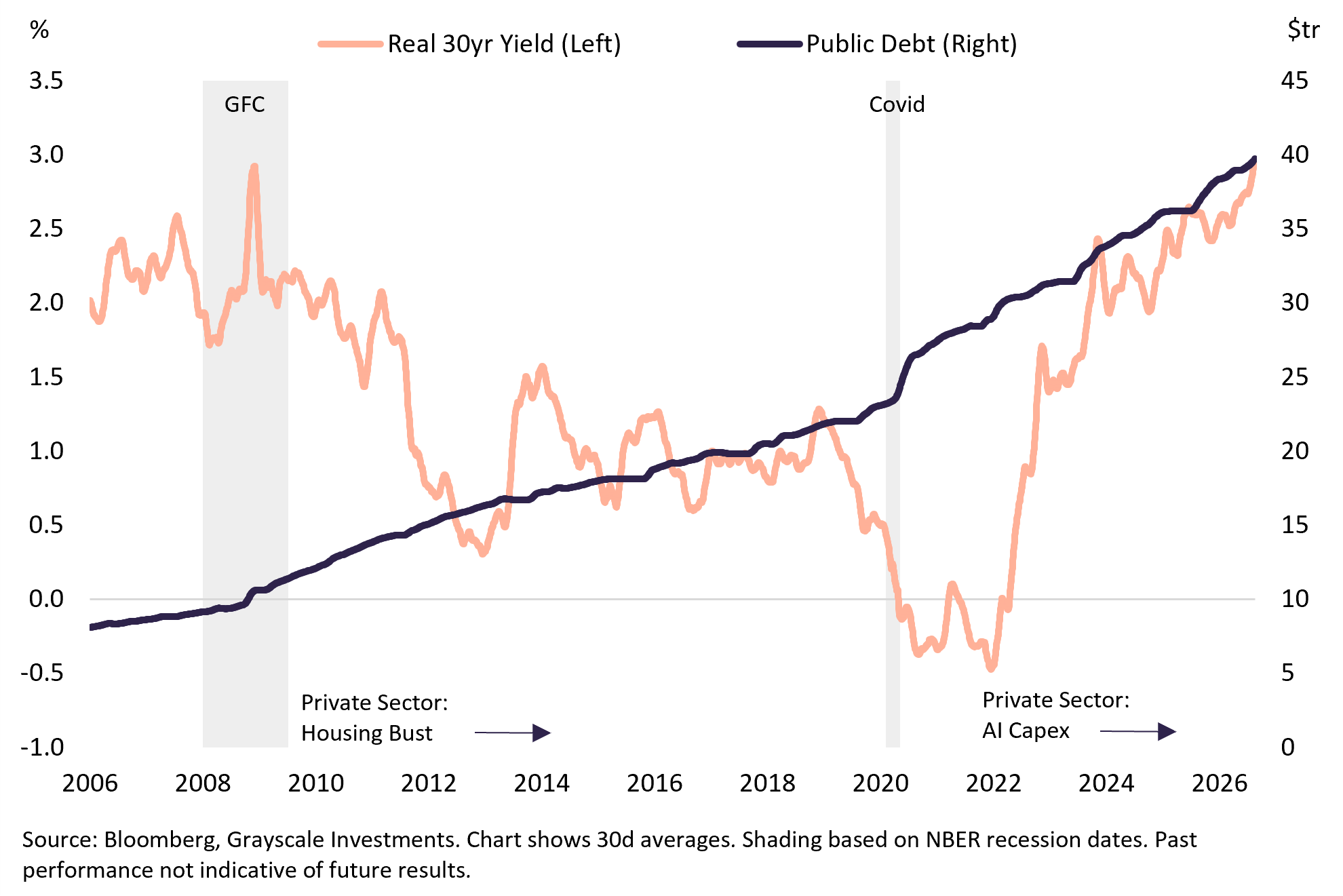
On the same day last week as the buyback announcement, the Treasury also said the US public debt exceeded $40 trillion for the first time (Exhibit 1).2 The debt stock has been rising almost continuously since the global financial crisis (GFC). Initially this had little bearing on interest rates because the housing bust meant the private sector was cutting back on borrowing. Now the private sector is borrowing heavily to fund the AI buildout. Too much borrowing is pushing up interest rates consistent with textbook economics.
Unchecked government debt growth undermines the credibility of fiat currencies and drives investors to seek out alternative stores of value like physical gold and certain cryptocurrencies—in digital assets we think the so-called “debasement trade” will primarily benefit Bitcoin, Ethereum, and Zcash.
Key Takeaway: Treasury buybacks treat the symptoms of structural budget deficits. Unchecked government debt growth may drive investors to alternative stores of value, in our view, potentially benefiting Bitcoin, Ethereum, and Zcash, among other digital assets.
Exhibit 1: Rising public debt is putting upward pressure on bond yields