Assets related to the development, production, or application of artificial intelligence technology.
Sectors represented by the FTSE Grayscale Crypto Sector Index Series using data from FTSE Russell as of November 4, 2026. Total index market cap is shown, including daily change. Indexes are unmanaged and one cannot invest directly in an index.
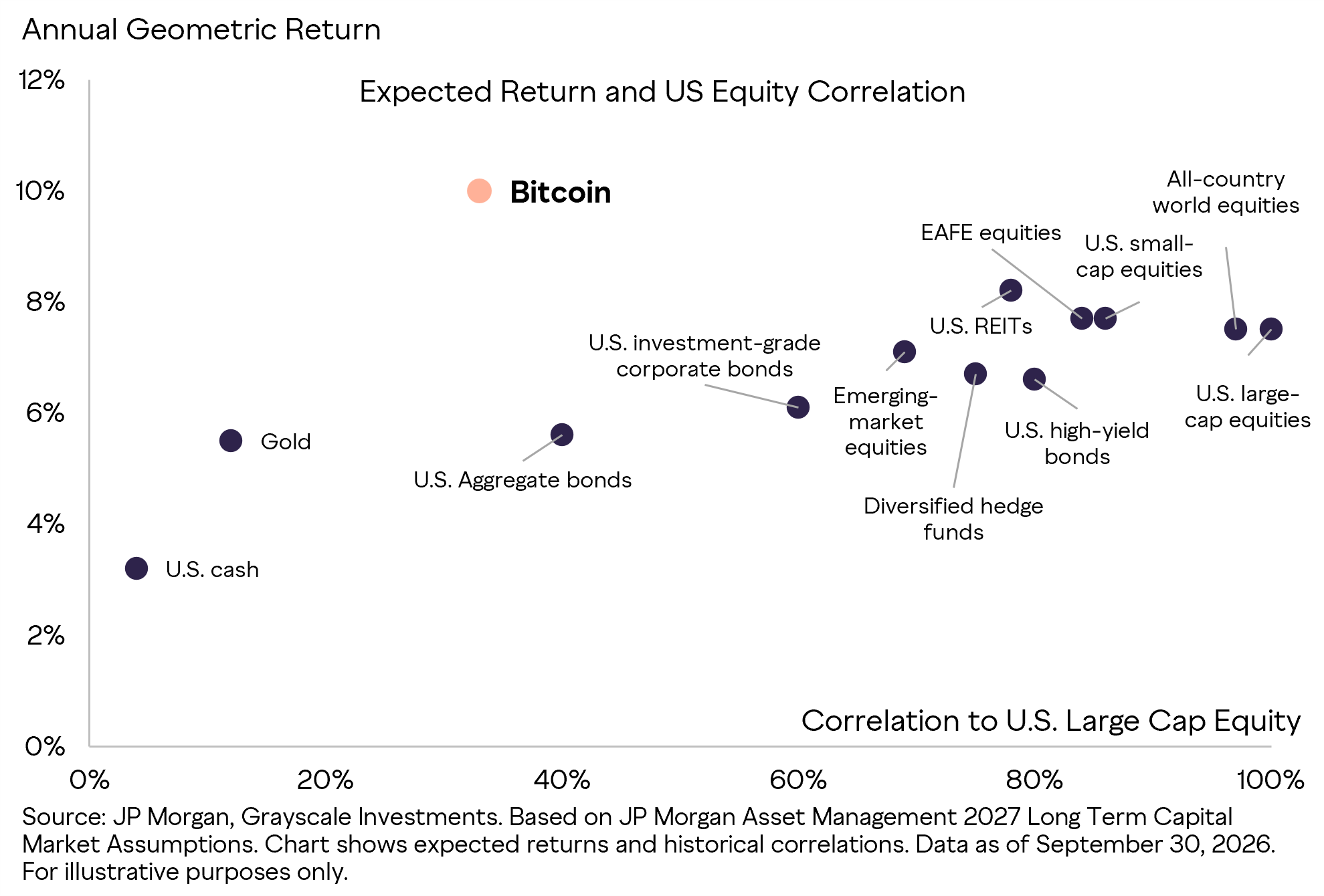
Bitcoin’s inclusion in J.P. Morgan Asset Management’s 2027 Long-Term Capital Market Assumptions1 marks another milestone in its evolution as an institutional asset. The $5 trillion investment manager now examines Bitcoin alongside established asset classes, forecasting a base-case compound annual return of 10% over the next decade alongside annualized volatility of 55%. These estimates bring Bitcoin’s potential rewards—and higher risks—into a familiar portfolio construction framework.
JPM’s assumptions highlight why Bitcoin deserves a closer look as a potential addition to traditional portfolios. Its projected 10% compound annual return exceeds estimated returns for all other asset classes, while its estimated correlation with US large cap stocks is just 33%—below international equities, corporate bonds, and hedge funds. Assets with high absolute returns and a low correlation to core equities are hard to find, and these features make Bitcoin a potentially attractive portfolio diversifier (Exhibit 1).
Bitcoin’s growing institutional recognition does not mean its portfolio role is settled. JPM remains cautious about unstable correlations and excludes Bitcoin from its main covariance matrices. Our analysis illustrates the potential portfolio benefits under the stated assumptions; the realization of those benefits will depend on how Bitcoin’s returns and relationships with other assets evolve.
Key Takeaway: Bitcoin’s inclusion in JPM’s long-term assumptions is another institutional milestone. Bitcoin’s relatively high expected returns and low correlations with large cap equities make it a potentially attractive portfolio diversifier.
Exhibit 1: Capital market assumptions set Bitcoin apart in return and correlation
The capital market assumptions summarized herein are sourced from third-party asset managers and are presented for informational and illustrative purposes only. Grayscale does not warrant their accuracy or completeness. These assumptions reflect each firm’s judgment based on current market conditions, are subject to change without notice, and are not promises or estimates of actual returns any portfolio may achieve. Nothing in this material constitutes investment, accounting, legal, or tax advice, or a recommendation to buy or sell any security, asset class, or strategy, and past performance is not a reliable indicator of future results.
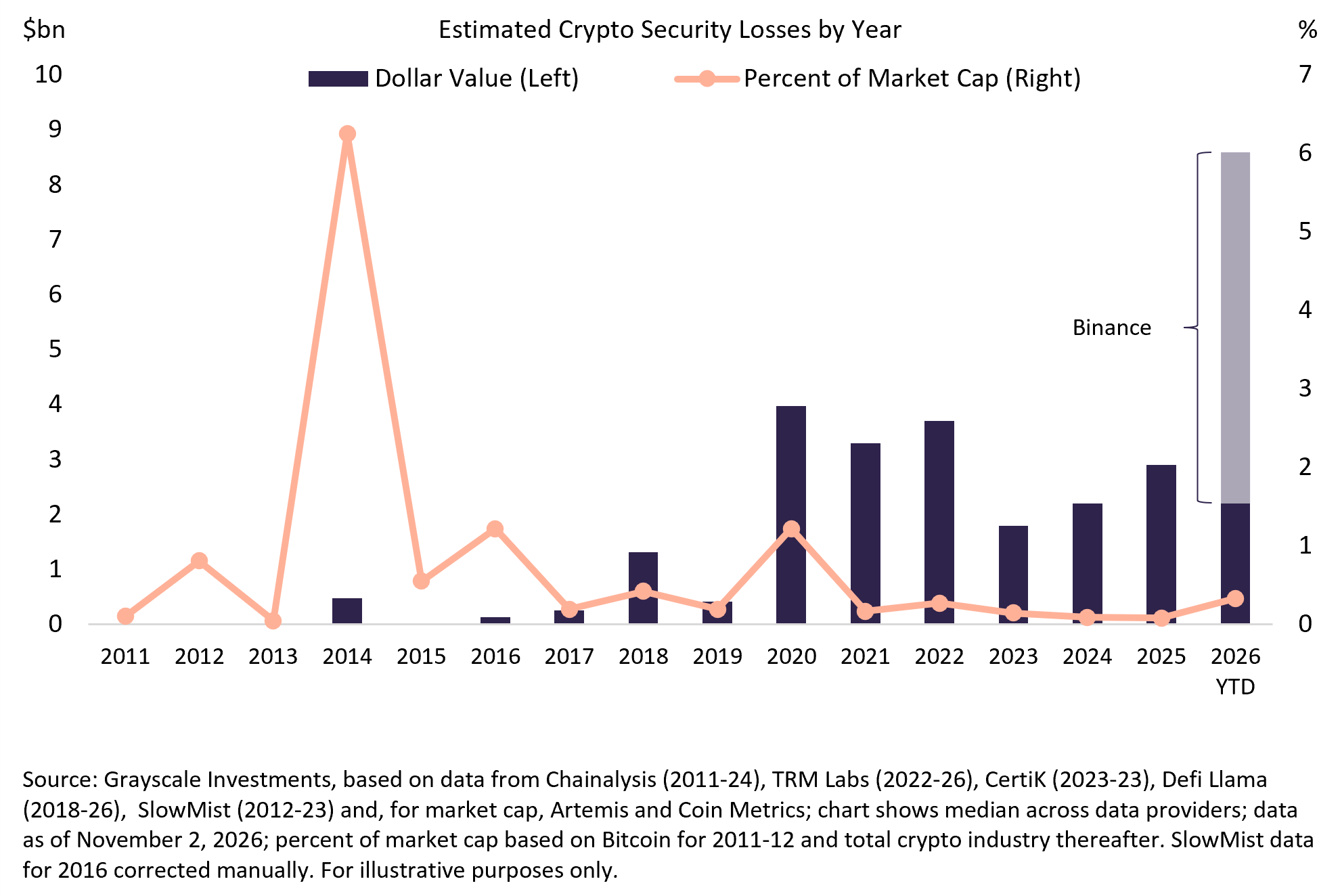
The hack on Binance drained more than $6 billion in assets from the world’s largest crypto exchange on Oct. 19.1 The cyber intrusion, attributed to North Korea,2 takes crypto security losses to a new high of more than $8 billion in 2026 (excluding it, however, makes losses so far in 2026 comparable to last year). More importantly, losses have declined significantly relative to total crypto market capitalization over time (Exhibit 1).3
Binance has been able to swiftly restore customer positions in the aftermath of the attack. The exchange said that 95% of the affected assets have, as of this writing, been fully covered (the remaining 5% of less liquid tokens will take longer to restore).4 In other words, Binance customers will bear none of the loss. Also, about $2.9 billion (~45%) of the stolen funds have been frozen by stablecoin issuers, including Tether and Circle. Issuers regularly work with law enforcement, and we can expect these funds to be returned to Binance.5
So what does this hack mean to US crypto investors?
First, while it may be a temporary setback for market confidence, we believe it will ultimately result in stronger security practices for all exchanges.
Second, we believe that it stresses the importance of institutional custody for crypto assets. In fact, a growing number of US-based investors have been using crypto exchange-traded products (ETPs)—which offer the convenience of institutional custody—to gain exposure to digital assets.
These vehicles typically include segregated holdings, offline storage, multi-signature wallets, strict internal processes, and insurance policies. For many crypto assets, investors can contribute tokens in-kind into US-listed ETPs, retaining their original cost basis while also seeking to upgrade security.
Key Takeaway: Unfortunate as it is, the Binance hack will, in our view, result in stronger security practices for exchanges going forward. It also underscores the importance of institutional custody, such as offered by US-based crypto ETPs. These vehicles hold their assets at state-charted banks and qualified custodians, typically offering offline storage, multi-signature wallets, SOC attestations, and insurance policies.
Exhibit 1: Crypto security losses have trended lower as a share of market cap
Source: Chainalysis. Binance is the largest crypto exchange based on year-to-date trading volume both for spot and perpetual futures, according to Coin Metrics data as of November 2, 2026.
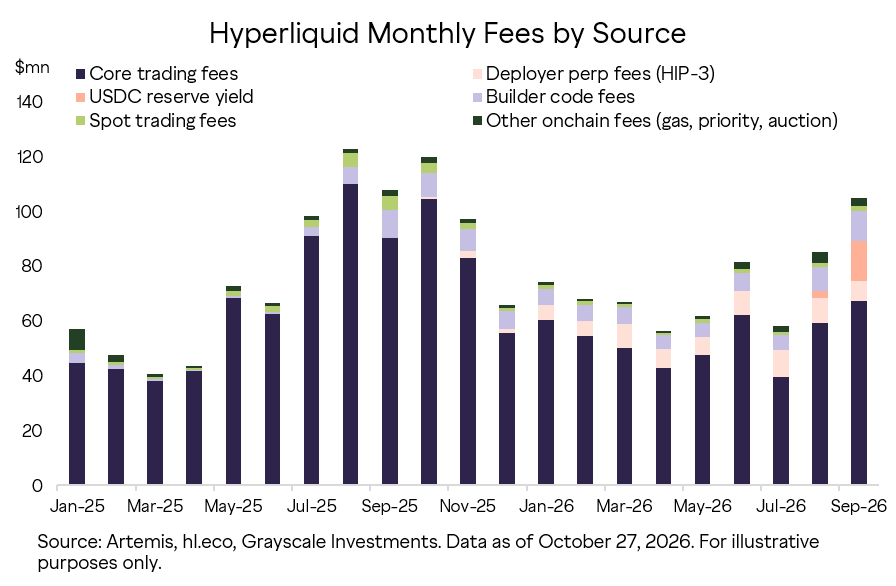
Hyperliquid, a decentralized exchange and innovative blockchain-based trading platform, generated about $105 million in revenue in September 2026. This is about the same as a year earlier ($108 million) despite the intervening crypto bear market.1 Hyperliquid revenue has remained strong partly because activity on the platform has become more diversified.
In mid-2025, core trading fees (from perpetual futures contracts on crypto assets listed by the Hyperliquid team) made up over 90% of revenue. Today they’re about 64% (Exhibit 1). The rest now comes from newer sources as Hyperliquid grows from an exchange into a broader financial platform. Specifically:
Deployer perps (HIP-3): Third parties list perpetual futures contracts on assets like silver, oil, and pre-IPO equities. These entities can capture up to half of the trading fees, with the rest going to the Hyperliquid protocol.
Builder codes: Wallets like Phantom, user-facing trading interfaces like Hyperdash, and exchanges like VALR, route orders to Hyperliquid and charge a fee on top, making Hyperliquid a liquidity layer for other platforms.
USDC reserve yield: Under a deal with Coinbase and Circle, Coinbase passes 90% of reserve income from roughly $6 billion in the USDC stablecoin held on Hyperliquid to the platform.
Spot, gas, and auctions: Hyperliquid also earns fees on spot trading in assets like BTC, ETH, and HYPE, plus HyperEVM gas, priority fees, and ticker auctions for new token listings. Together, these brought in about $5 million in September, a small but growing source of revenue.
In our view, the mix matters as much as the total. Non-core revenue was $38 million in September, double what it was a year earlier. Reserve yield in particular depends on deposits and interest rates rather than trading volume, which makes it a steadier income stream.
Looking ahead, regulated access for US traders could be the next lever of growth. Kraken parent Payward intends to become the first CFTC-regulated deployer on HIP-3*, a version of HIP-3 that lets deployers restrict markets to approved, KYC’ed users, while ICE, owner of the New York Stock Exchange, has partnered with leading HIP-3 deployer Trade.xyz to build a US-regulated perpetual futures market on Hyperliquid infrastructure.2
Key Takeaway: Hyperliquid has diversified its revenue meaningfully over the past year. Roughly a third now comes from third-party markets, distribution partners, and stablecoin yield, making the protocol less dependent on the crypto perps it lists itself. Pending US-regulated deployments could open further avenues for growth.
Exhibit 1: Hyperliquid’s revenue is increasingly diversified
The US midterm elections are next week, and prediction markets suggest the Democrats may take control of both the House and Senate (where Republicans currently hold majorities). The digital assets industry has benefited from improved regulatory clarity in recent years, and a change in control of Congress is unlikely to materially affect the outlook. Here is why, in our view:
First, crypto is bipartisan. Data from Pew Research and The Harris Poll show that roughly the same number of Republicans and Democrats hold or use crypto.1 The GENIUS Act passed Congress with bipartisan support, and earlier legislation during the Biden Administration2 also received votes from Democrats. Perhaps most importantly, federal government debt will likely continue to grow unchecked regardless of the makeup of Congress, driving investors to alternative stores of value including cryptocurrencies.
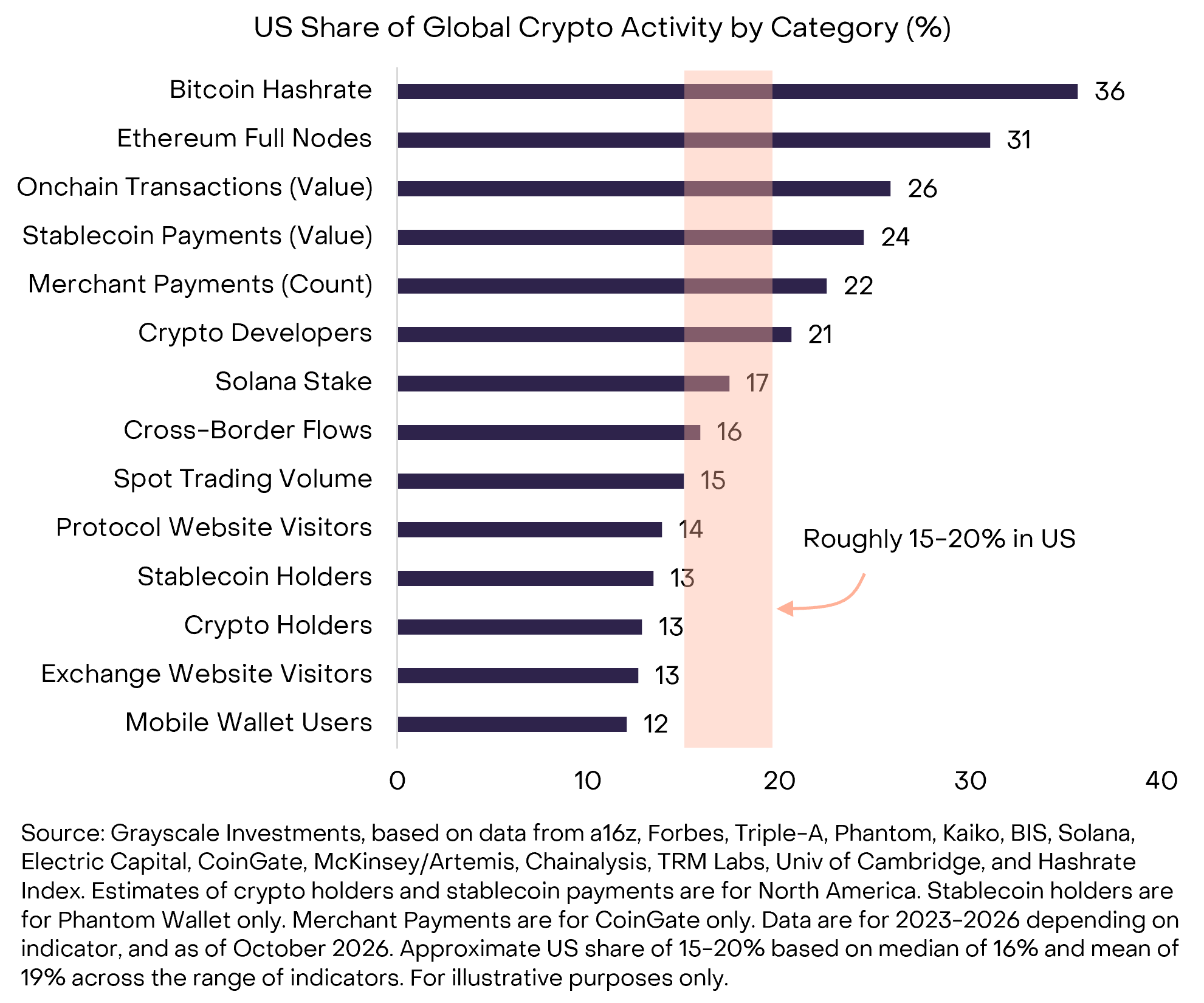
Second, crypto is global. We estimate that roughly 15-20% of global crypto activity occurs in the US—the remaining 80-85% is overseas (Exhibit 1). Regardless of the outcome of the US midterms, users around the world will continue to seek out alternatives to fiat currencies as well as more effective payment systems, and foreign regulators will continue to put in place rules to support digital assets innovation in their jurisdictions.
Third, crypto is institutional. Public blockchain technology is now more deeply embedded into the mainstream financial system, facilitated by institutional adoption. Leading payments providers are building with stablecoins (e.g., Visa, Mastercard, Fiserv, and Stripe), major asset managers have tokenized their funds (e.g., Franklin Templeton, BlackRock, and JPMorgan), and crypto exchange-traded products (ETPs) are now held by many institutional portfolios.3 The private sector has already embraced digital assets.
Key Takeaway: Elections can affect crypto on the margin, just like other asset classes. But the digital assets industry is bipartisan, global, and increasingly institutional, so we believe it will continue to move forward regardless of the outcome of the US midterms.
Exhibit 1: We estimate that roughly 15-20% of global crypto activity occurs in the US