
The digital assets industry has started exporting its innovations to traditional finance. Stablecoins were the first export, followed by tokenized assets. The next will be perpetual futures—a type of derivative contract without an expiration date. On Friday, May 29, the CFTC approved the first perpetual futures contract on a US regulated venue. This is a positive step for regulated U.S.-based platforms like Kalshi and Polymarket and we see it as a step toward a future in which decentralized finance (DeFi) platforms specializing in perpetual futures, such as Hyperliquid, are available to US users as well (see our full report Hyperliquid Breaks the Mold).
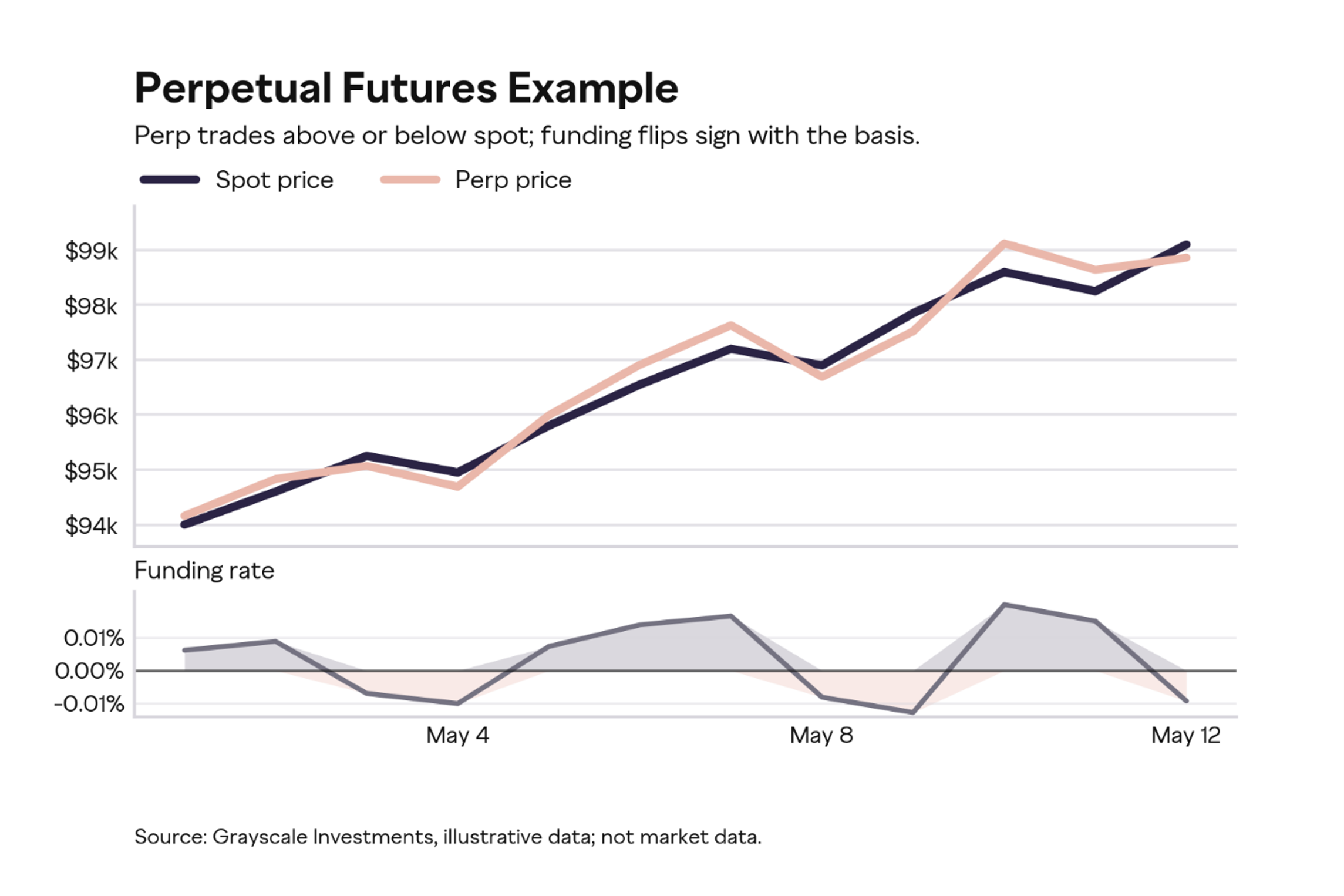
Traditional futures have an expiration date and often require delivery of the underlying asset. Perpetual futures have no expiration date, and no one ever takes or receives delivery. So how does the price stay connected to the underlying? Perpetual futures use a mechanism called the funding rate—a small periodic payment between longs and shorts. When the futures price trades above the spot price, longs pay shorts; when it trades below, shorts pay longs—the bigger the difference, the larger the payment (Exhibit 1). The funding rate therefore creates an economic incentive to bring the perpetual futures price back toward the underlying market. Perpetual futures, like total return swaps, allow investors to create pure financial exposure to an asset or price index.
Key Takeaway: The CFTC’s approval of US perpetual futures contracts can be seen as a step toward a future in which trading on decentralized exchanges such as Hyperliquid is available to US users.
Exhibit 1: Perpetual futures use a funding rate mechanism to help keep futures prices close to spot
Related
© 2026 Grayscale. All rights reserved
All data sourced from Bloomberg as of the date of publication, unless otherwise noted.
Investments in digital assets are speculative investments that involve significant risk, including a partial or total loss of invested funds. Investments in digital assets are not suitable for any investor that cannot afford loss of the entire investment.
This information should not be relied upon as research, legal, tax or investment advice, or a recommendation regarding any products, strategies, or any investment in particular. This material is strictly for illustrative, educational, or informational purposes and is subject to change. This content does not constitute an offer to sell or the solicitation of an offer to sell or buy any security in any jurisdiction where such an offer or solicitation would be illegal. There is not enough information contained in this content to make an investment decision and any information contained herein should not be used as a basis for this purpose. Readers are encouraged to seek guidance from qualified professionals.
Index returns are presented for illustrative purposes only and exclude management fees and expenses. Indexes are unmanaged, and investors cannot invest directly in an index. A basis point (bps) is one hundredth of one percent (e.g. one basis point = 0.01%).
Grayscale Operating, LLC and its affiliates, directors, officers, and employees may have interests, financial or otherwise, in the digital assets and/or securities discussed.
Certain of the statements contained herein may be statements of future expectations and other forward-looking statements that are based on Grayscale’s views and assumptions and involve known and unknown risks and uncertainties that could cause actual results, performance, or events to differ materially from those expressed or implied in such statements. In addition to statements that are forward-looking by reason of context, the words “may, will, should, could, can, expects, plans, intends, anticipates, believes, estimates, predicts, potential, projected, or continue” and similar expressions identify forward-looking statements. Grayscale assumes no obligation to update any forward-looking statements contained herein and you should not place undue reliance on such statements, which speak only as of the date hereof. Although Grayscale has taken reasonable care to ensure that the information contained herein is accurate, no representation or warranty (including liability towards third parties), expressed or implied, is made by Grayscale as to its accuracy, reliability, or completeness. You should not make any investment decisions based on these estimates and forward-looking statements.
Specific companies, issuers, platforms, or protocols are mentioned for educational purposes only and should not be deemed a recommendation to buy or sell any securities, digital assets, or other financial instruments. Any entities mentioned do not necessarily represent current or future holdings of any Grayscale products.
All content is original and has been researched and produced by Grayscale Investments Sponsors, LLC (“Grayscale”) unless otherwise stated herein. No part of this content may be reproduced in any form, or referred to in any other publication, without the express consent of Grayscale.
© 2026 Grayscale. All trademarks, service marks and/or trade names (e.g., G™, GRAYSCALE®, GRAYSCALE CRYPTO SECTORS™, and GRAYSCALE INVESTMENTS®) are owned and/or registered by Grayscale.