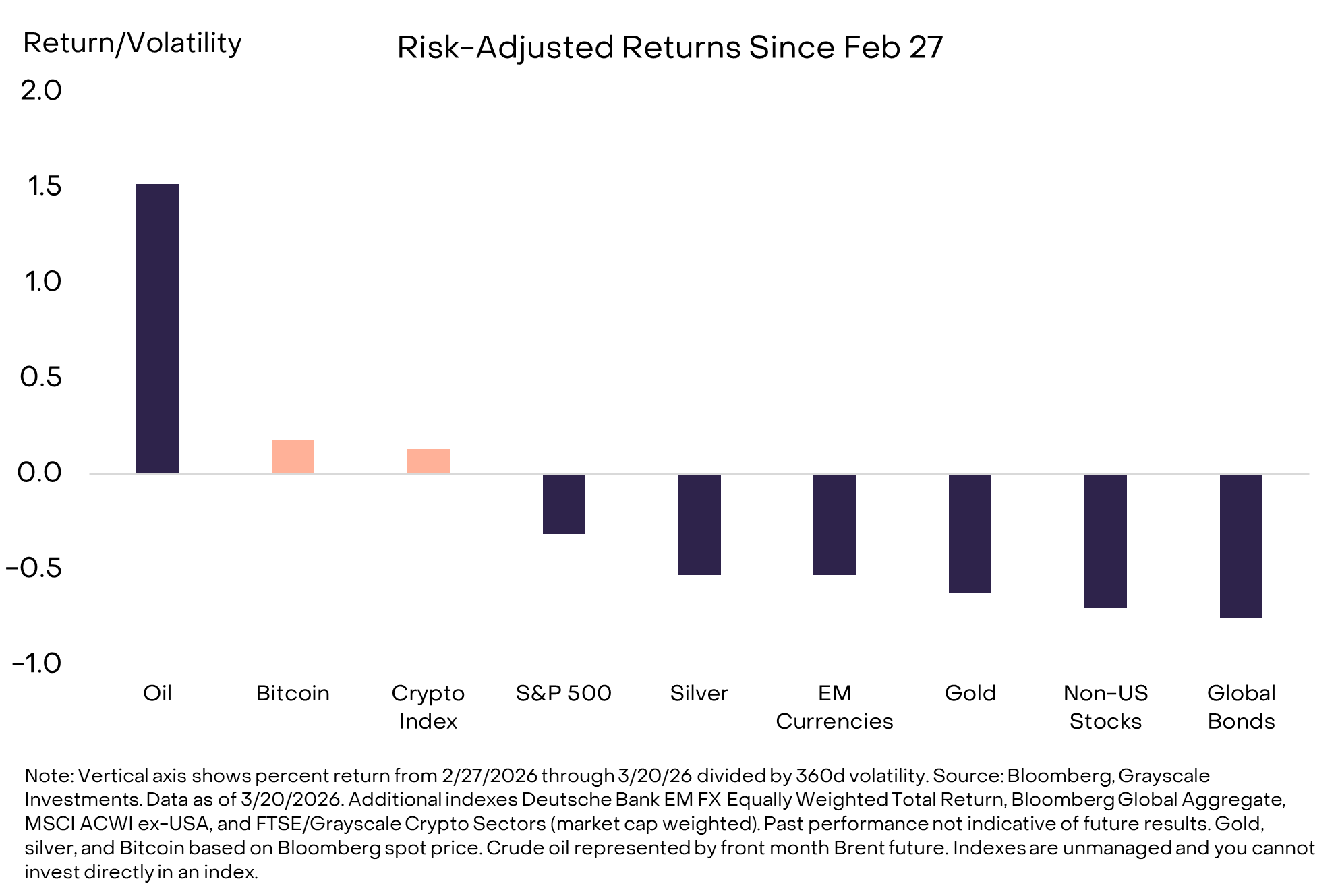
The war in Iran has entered its fourth week. For the world economy, the most important implication is a meaningful oil price shock: spot oil prices are ~$40/bbl higher (+55%) and longer-dated futures are now moving up as traders anticipate longer supply disruptions.¹ The potential for sharply higher inflation has resulted in a repricing of central bank expectations: 1yr swap rates are up ~40bp in US, ~60bp in the Euro Area, and ~100bp in the UK. Broad equity indexes, government bonds, and precious metals are all lower (see chart).
Amidst all this, crypto assets have eked out a small gain, likely reflecting, in our view:
Oversold conditions. The crypto selloff from October to early February drove a substantial reduction in risk taking, and this has started to recover. Over the last two weeks, despite the broader market volatility, spot crypto ETPs have seen net inflows and perpetual futures open interest has picked up.²
Positive fundamental news. Crypto-specific news has been positive, including a potential breakthrough in negotiations around the CLARITY Act, new SEC guidance defining most crypto assets as non-securities, and ongoing institutional investment (e.g. Mastercard’s recent acquisition of stablecoin infrastructure provider BVNK).³
Independence of blockchains. Crypto assets are grounded in open-source software running on networks of computers. They are not correlated to oil prices⁴ or dependent on any one nation or government. Bitcoin, for instance, will continue to produce blocks every ten minutes (on average) regardless of how the military conflict unfolds.
Key Takeaway: Crypto has held up well since the start of the war with Iran. Valuations could see a more meaningful recovery once macro risks recede, in our view.
¹ Source: Bloomberg. Data as of March 20, 2026. Spot oil prices based on front month Brent future. ² Source: Coin Metrics. Data as of March 20, 2026.
⁴ Over the last 1yr, the daily return correlation between Bitcoin and crude oil was 0.07. Source: Grayscale Investments based on data from Bloomberg. Data as of March 23, 2026. Past performance not indicative of future results.