On Tuesday the Securities and Exchange Commission (SEC) issued new interpretive guidance on the application of Federal securities laws to crypto assets, putting to rest a number of long-standing questions that have bedeviled crypto entrepreneurs (and their lawyers).
The guidance included three specific elements:
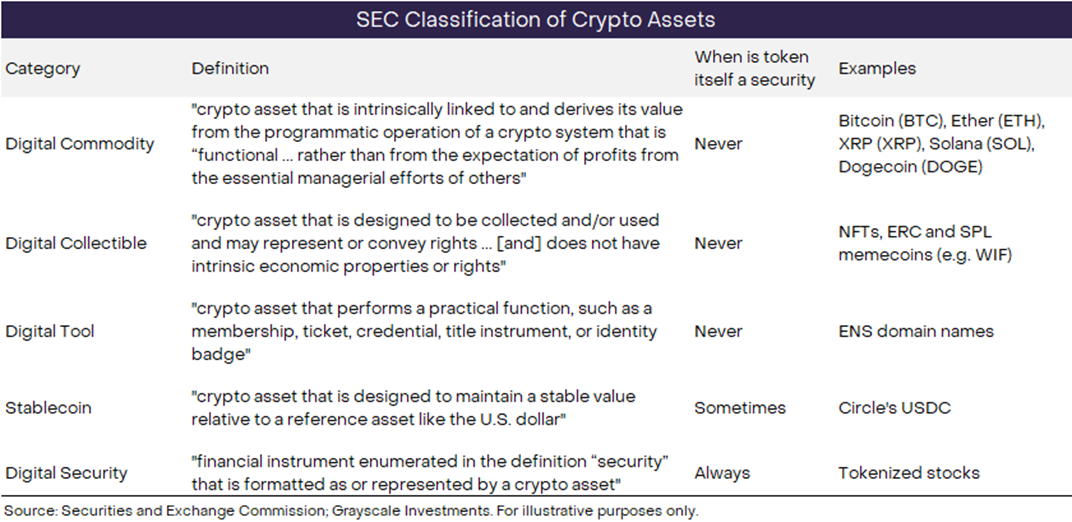
Taxonomy of crypto assets: The SEC categorizes crypto assets into five distinct groups (see table below). Digital securities are securities (obviously). Stablecoins can be securities (if they are not GENIUS Act-compliant and offer security-like elements). All other crypto assets are not securities.
The key for most tokens is their “functional” use case. Where a token is intrinsically linked to and derives its values from the operation of a crypto system, the SEC has determined these are de facto non-securities.
SEC-provided examples of specific tokens for which this is the case: Aptos (APT); Avalanche (AVAX); Bitcoin (BTC); Bitcoin Cash (BCH); Cardano (ADA); Chainlink (LINK); Dogecoin (DOGE); Ether (ETH); Hedera (HBAR); Litecoin (LTC); Polkadot (DOT); Shiba Inu (SHIB); Solana (SOL); Stellar (XLM); Tezos (XTZ); and XRP (XRP), all of which the SEC notes have CFTC-regulated futures contracts.
Extending the logic stated in the guidance, other examples would include: Aave (AAVE), Binance Chain (BNB), Ethena (ENA), Near (NEAR), Ondo (ONDO), Sui (SUI), and Zcash (ZEC). All of these assets have CFTC-regulated futures.¹
Distinction between tokens and tokens subject to an investment contract (e.g., token sales). Most tokens are not securities, but even non-security tokens can be subject to an “investment contract” and therefore subject to SEC registration. Here the SEC applies standard Howey test logic: if the offering or sale of a token comes with an investor reasonably expecting profit from the essential managerial efforts of the issuer, then a crypto asset becomes subject to an investment contract and is part of a securities offering.
Clarifications on mining, staking, wrapped assets, and airdrops. Generally speaking, these activities are not considered securities transactions.
The Commodities Futures Trading Commission (CFTC) said it would apply its oversight responsibilities in a manner consistent with the SEC’s new guidance.
What does this mean in practice? Blockchains offer alternative methods for capital formation, but potential issuers want to make sure they follow all applicable laws. The new joint SEC-CFTC guidance reduces uncertainty and may therefore stimulate new investment activity in the United States. For investors in crypto assets, the direct implications are (i) lower regulatory tail risks and (ii) potentially more blockchain activity from higher new token issuance, which ultimately drives value back to the underlying networks and their native assets (e.g., ETH, SOL, SUI, BNB, and AVAX).
Key takeaway: New SEC guidance clarifies that most crypto assets are not securities and may help stimulate new capital formation in the US.