
Start Investing

The Stack

Crypto Intelligence
By Zach Pandl, Head of Research

April 24, 2026

No Need to Stretch for Bitcoin Exposure

Zach Pandl
By Zach PandlGrayscale Head of Research

Share

Investors have different options for adding Bitcoin exposure to a portfolio, including buying on an exchange and holding there or in self-custody, purchasing an exchange-traded product (ETP), or investing in securities issued by digital asset treasuries (DATs)—public companies like Strategy that operate primarily as Bitcoin investment vehicles. Each option has pros and cons, but many investors believe spot ETPs are still the cleanest way to add Bitcoin exposure to standard brokerage and retirement accounts.


Bitcoin DATs issue an increasingly diverse array of instruments, including common equity, preferred shares, and convertible bonds.

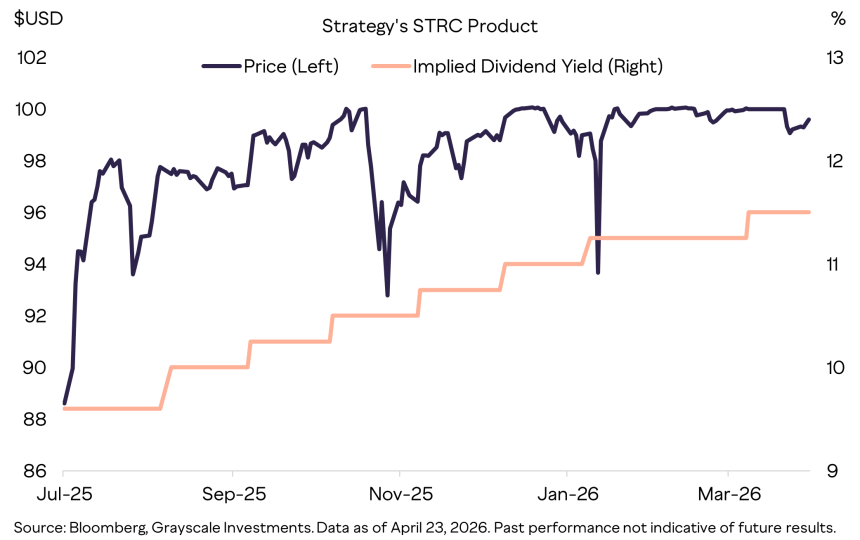
The latest DAT structure to take off has been Strategy’s “stretch” (STRC) product, a variable rate preferred equity instrument. Stretch  is designed to trade at a share price around $100 and currently pays an annual dividend  yield of 11.5%. If the secondary price falls below $100, Strategy can raise the dividend to entice demand. If the price rises above $100, Strategy can reduce the dividend (see chart). So far Strategy has issued nearly $6 billion of its STRC product. Strive, another Bitcoin DAT, has also seen success with its variable rate preferred instrument, which has a yield of 12.5%. Given  existing investor demand, more issuers may come to market.

Investors considering variable rate preferred shares issued by Bitcoin DATs may want to consider three key factors:

  1. They are a directional bet on the price of Bitcoin. Unlike proof-of-stake blockchains (e.g., Ethereum and Solana), Bitcoin does not offer a native yield, and most DATs do not generate much operating income.  Therefore, the ability of issuers to pay preferred dividends over the longer-term depends on the price of Bitcoin rising.

  2. They are risky yield-bearing instruments. STRC and SATA offer yields comparable to CCC corporate bonds (~11%).[i] Yields have been relatively high because a) the shares are low on the capital structure, b) they  are issued by companies with limited operating cash flow, and c) they are dependent on the price of Bitcoin, which itself has an annualized volatility of about 50%.[ii]

  3. Bitcoin covered call strategies can offer an attractive yield. Variable rate preferred shares are structurally similar to covered call strategies: They pay a roughly steady yield in favorable scenarios but are exposed to the price of Bitcoin in downside scenarios.[iii] Currently, at-the-money Bitcoin calls offer an implied yield of about 33%, meaning covered call writing has the potential to outperform STRC or SATA if Bitcoin’s price stays unchanged or moves slightly higher over the life of the option.[iv]


If the price of Bitcoin rises, most Bitcoin-linked investment vehicles can be expected to deliver positive returns. Our optimistic outlook for Bitcoin therefore implies a favorable backdrop for DAT-issued instruments, including variable rate preferred shares. However, the return profile of these structures may be quite different than Bitcoin itself—especially on the upside.


Spot Bitcoin ETPs are comparatively simple: They own Bitcoin in institutional custody. This means they are exposed to the price of Bitcoin on the downside, but also to the full range of upside scenarios. For investors focused primarily on income, dividend-paying instruments or covered call strategies may be appropriate. For investors seeking directional exposure to the price of Bitcoin, spot ETPs (or self-custody) are arguably the better bet.


Key Takeaway: Many investors believe spot ETPs are still the cleanest way to get Bitcoin investment exposure in standard brokerage or retirement accounts.

[i] Source: Bloomberg US CCC High Yield Index yield to worst. Data as of April 21, 2026
[ii] Source: Bloomberg, based on realized 360d price volatility of 51.8% as of April 21, 2026.
[iii] The correlation between these two strategies in downside scenarios will depend on how much the price of Bitcoin falls (among other factors). In moderate downside scenarios preferred shares should outperform, especially if the issuer holds US dollar cash on balance sheet and uses it to pay the preferred dividends. In severe downside scenarios the correlation may depend on whether the DAT liquidates Bitcoin to continue paying the preferred dividends.
[iv] Based on 3m tenor calls. Source: Derebit, Kaiko, Grayscale Investments. Data as of April 24, 2026.

Related

Crypto Currencies

Sep 14, 2026

Can Bitcoin Improve Private Market Portfolios?
READ

Crypto Currencies

Sep 8, 2026

Risk Management and Income with Zcash Options
READ

Crypto Currencies

Sep 1, 2026

Digital Assets Can Help Diversify Equity Concentration Risk
READ

Want The Stack delivered directly to your inbox?