In the mid-1990s, MIT mathematician Peter Schor developed an algorithm for a quantum computer that could rapidly solve the “hard number problems” that underpin classical cryptography. Even 30 years later, a machine capable of running Schor’s algorithm at scale still does not exist, and it probably will not for at least a few more years. But a new research paper from Google Quantum AI makes the case that because timelines are uncertain, the best course of action is to harden public blockchains now. Grayscale finds the argument persuasive and supports accelerated efforts toward quantum readiness.
The Google whitepaper, which is a great read, offers a detailed technical summary of all the relevant issues. Four points stand out:
It’s time to get started. While there is no quantum computer capable of running Schor’s Algorithm at scale today, progress toward this goal may come in “discrete jumps” rather than linearly, so waiting on further innovation could be risky. The “finish line” may also be closer than many think, requiring just 1,200 to 1,450 logical qubits—a measure of the computational capacity of a quantum computer. In the meantime, there is a lot of work to do across blockchain communities in terms of engineering, consensus building, and addressing second-order effects (e.g., potentially lower transaction throughput).
This is a solvable problem. The Google paper balances urgency with optimism. The path forward is “technically clear”: blockchains need to adopt post-quantum cryptography; this is a “mature cryptographic discipline” with tools that have been “proposed, scrutinized, implemented, and deployed.” These systems are already securing internet traffic and certain blockchain transactions. Both Solana and the XRP Ledger are already experimenting with post-quantum cryptography.
Quantum risk differs across blockchains. Potential security vulnerabilities from advanced quantum computers depend on whether the blockchain uses a UTXO model (like Bitcoin) or an account model (like Ethereum), whether consensus derives from proof-of-work or proof-of-stake, whether there are smart contracts, whether there was a setup process (as with certain privacy tools), and the amount of time between blocks.
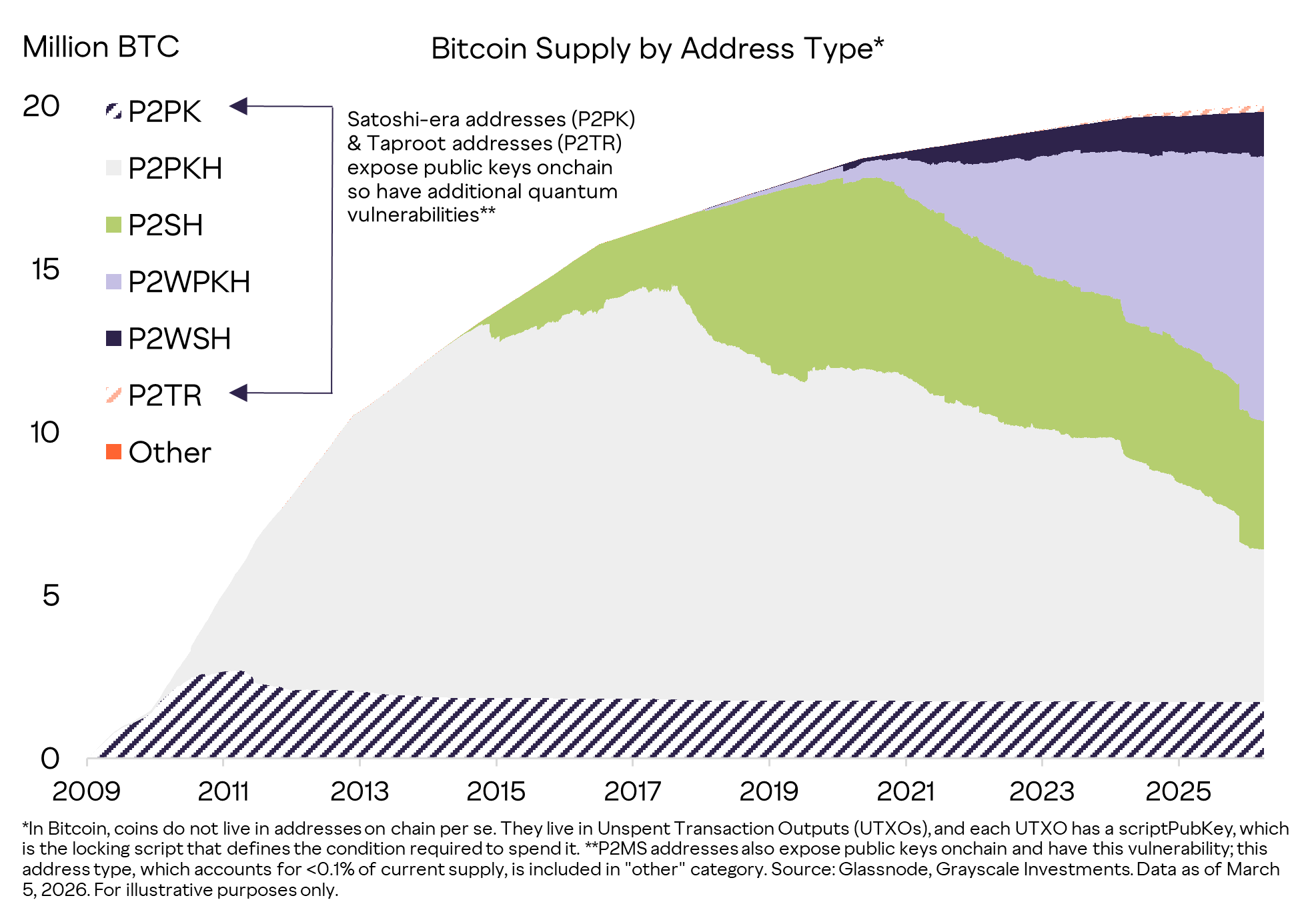
Bitcoin’s challenges are more social than technical. Strictly from an engineering standpoint, Bitcoin has lower risk than other cryptocurrencies: it uses a UTXO model and proof-of-work consensus, does not have native smart contracts, and certain address types are not quantum vulnerable (if not reused after spending). (See chart.) However, the Bitcoin community needs to decide what to do about coins where the private key has been lost or is otherwise inaccessible—they could decide to burn the coins, do nothing, or deliberately slow their release (by limiting the rate of spending from vulnerable addresses). All are conceptually doable, but the challenge is reaching a decision, and the Bitcoin community has a history of contentious debates over protocol changes, including last year’s dispute around image data stored in blocks.
Every organization that uses classical cryptography—including banks, tech companies, and governments—needs to prepare for a post-quantum future. But these entities have the luxury of centralized governance—after an order from the top, the CTO is simply expected to get the job done. Public blockchains do not have CTOs; they are global communities governed by consensus. The potential threat to digital security from quantum therefore presents both a challenge and an opportunity. Blockchain communities will have to get organized around solutions and get them implemented in code. But when this is done (and we believe it is a matter of when not if), it will become even harder to deny the adaptive resilience of this decentralized financial technology.
Key Takeaway: Investors should not fret. In our view, there is no security threat to public blockchains from quantum computers today. But it’s time to accelerate efforts to prepare for our post-quantum future, and in doing so demonstrate the resilience of decentralized technology.
Related
NEW
Economics & Macro
Nov 16, 2026
Crypto Retreat Offers Entry Point, Fundamentals Still Solid