August 11, 2026

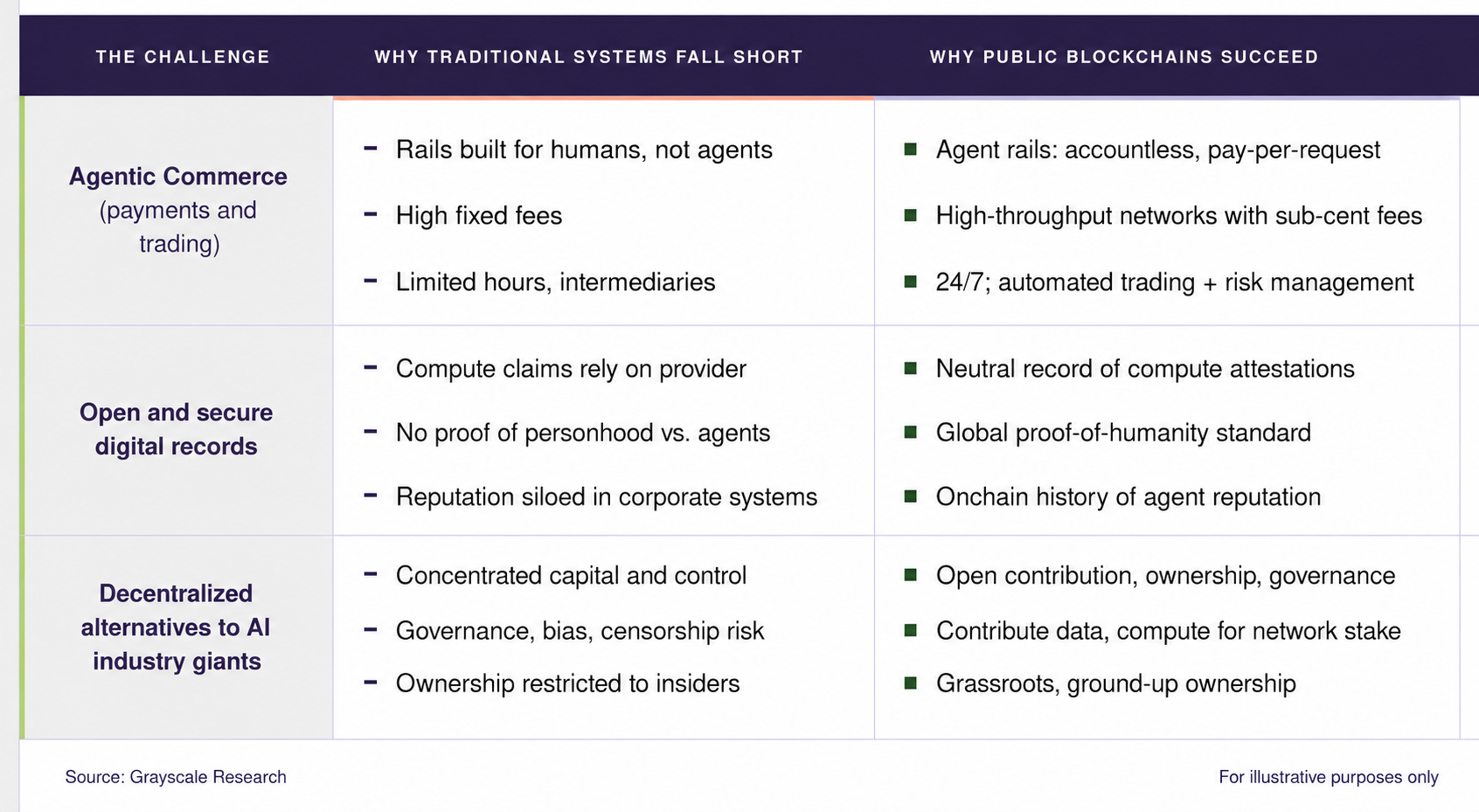
Artificial intelligence and public blockchains are complementary. As AI creates demands that traditional systems were not designed to meet, public blockchains offer new solutions (Exhibit 1). We have identified three areas where we believe the adoption of AI will create the most demand for blockchain technology: agentic finance, record keeping for computation and reputation, and decentralized AI alternatives.
Payments and finance provide the clearest examples. To act on our behalf, AI agents will need programmable wallets that can hold and deploy capital without intermediaries. Their activity will drive demand for micropayments, instant cross-border settlement, and automated trading and risk management. Public blockchains like Ethereum and Solana enable exactly this.
AI agents also create the need for verifiable records of computation, online human identity, and agent reputation. As enterprises delegate more decisions to AI, they will need to verify how those decisions were produced—including which models, data, and rules an agent used. Users, meanwhile, must be able to distinguish humans from agents online; for example, a social network may need to verify that an account represents a unique person without requiring that person to reveal their identity. Agents will also need trusted records of reputation before performing high-stakes tasks such as making investments or purchasing goods on a user’s behalf. Public blockchains—and applications built on them, such as Worldcoin's identity service—can anchor these records in transparent, neutral infrastructure rather than place them under the control of a single corporation or government.
Finally, decentralized networks offer an alternative to centralized AI ownership and governance. AI is concentrating capital, compute, and control among a handful of frontier labs and hyperscalers, raising concerns about governance, bias, and censorship. Decentralized networks like Bittensor offer a fundamentally different approach: global, open AI ecosystems that anyone can access, contribute to, and own a stake in.
Key Takeaway: AI adoption will increase demand for public blockchains as programmable financial infrastructure; a verifiable record layer for computation, identity, and reputation; and a foundation for open, user-owned AI ecosystems.
Exhibit 1: Public blockchains can meet the emerging needs of the AI economy