
May 12, 2026

The Ethereum community is considering changes to the network’s staking reward model to only incentivize staking up to a certain point. If implemented, the change would likely reduce nominal rewards for stakers. We think that such a change would be positive for the price of Ether (ETH) over time because a) it would help control ETH inflation, and b) would bolster the use case of ETH as a store of value.
There are two issues motivating the change:
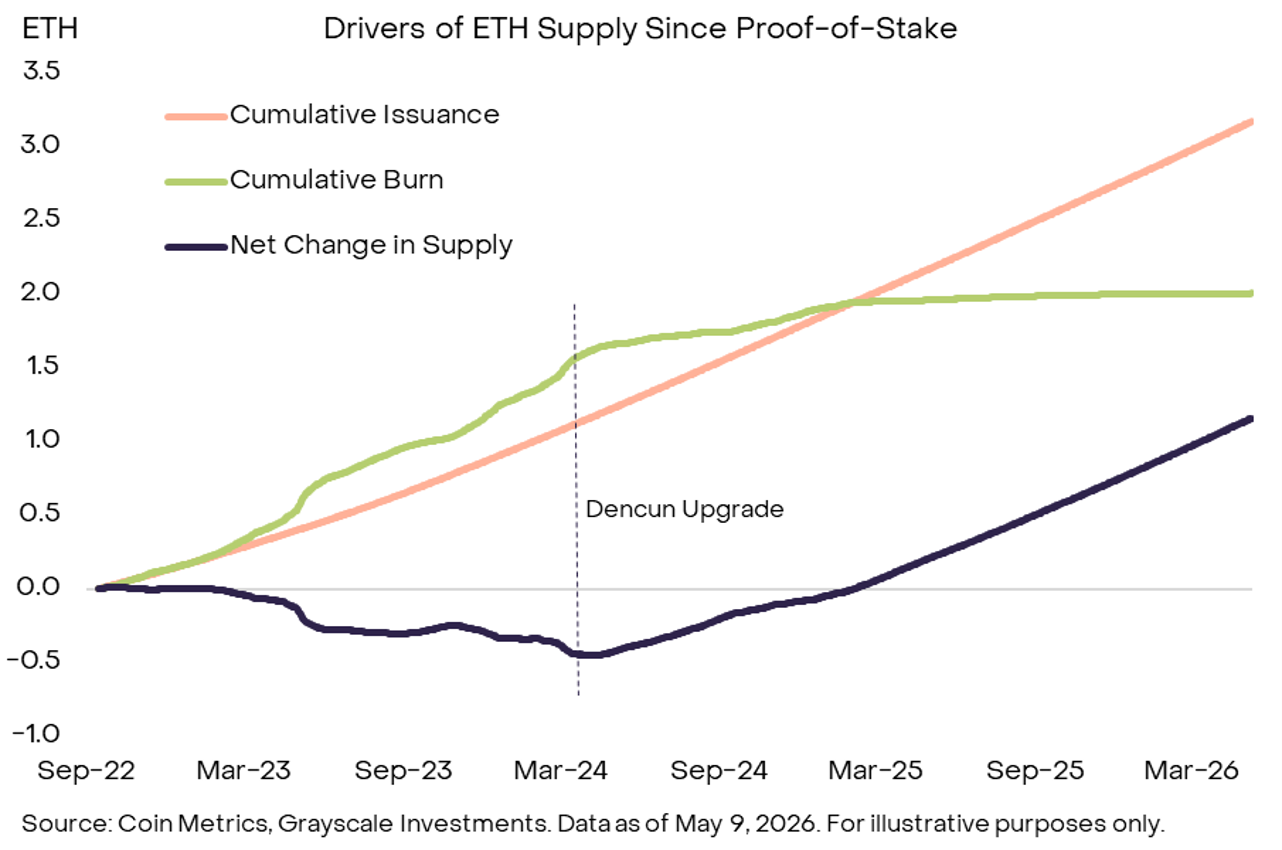
(1) Reduced token burn increasing net issuance. The supply of ETH depends on the difference between new issuance and token burn. Currently, all base transaction fees on the Ethereum Layer 1 (L1) are burned, meaning high transaction fees keep ETH supply growth in check. But in the last few years, more activity has shifted to Layer 2 (L2) networks, reducing L1 transaction fees and token burn. As a result, net issuance has risen (Exhibit 1). In addition, the Ethereum L1 is now increasingly opting for scale to compete with high capacity blockchains like Solana. This will likely mean relatively low L1 transaction fees for the foreseeable future, implying lower token burn, and more net supply growth.
Exhibit 1: Reduced token burn has resulted in higher net issuance
(2) Lower staking friction and unbounded staking demand. When Ethereum first introduced staking,1 users could not withdraw their assets—staked ETH was illiquid and therefore carried a risk premium. But withdrawals are now enabled, increasing liquidity and reducing the risk premium. Plus, exchange-traded products (ETPs) and digital asset treasuries (DATs) now stake ETH as well. As a result, the marginal cost to stake ETH is now arguably close to zero. If the network continues to offer marginal benefits to stakers, almost all ETH could eventually be staked.
Staking is necessary for the Ethereum protocol to function, but very high levels of staking may be counterproductive.
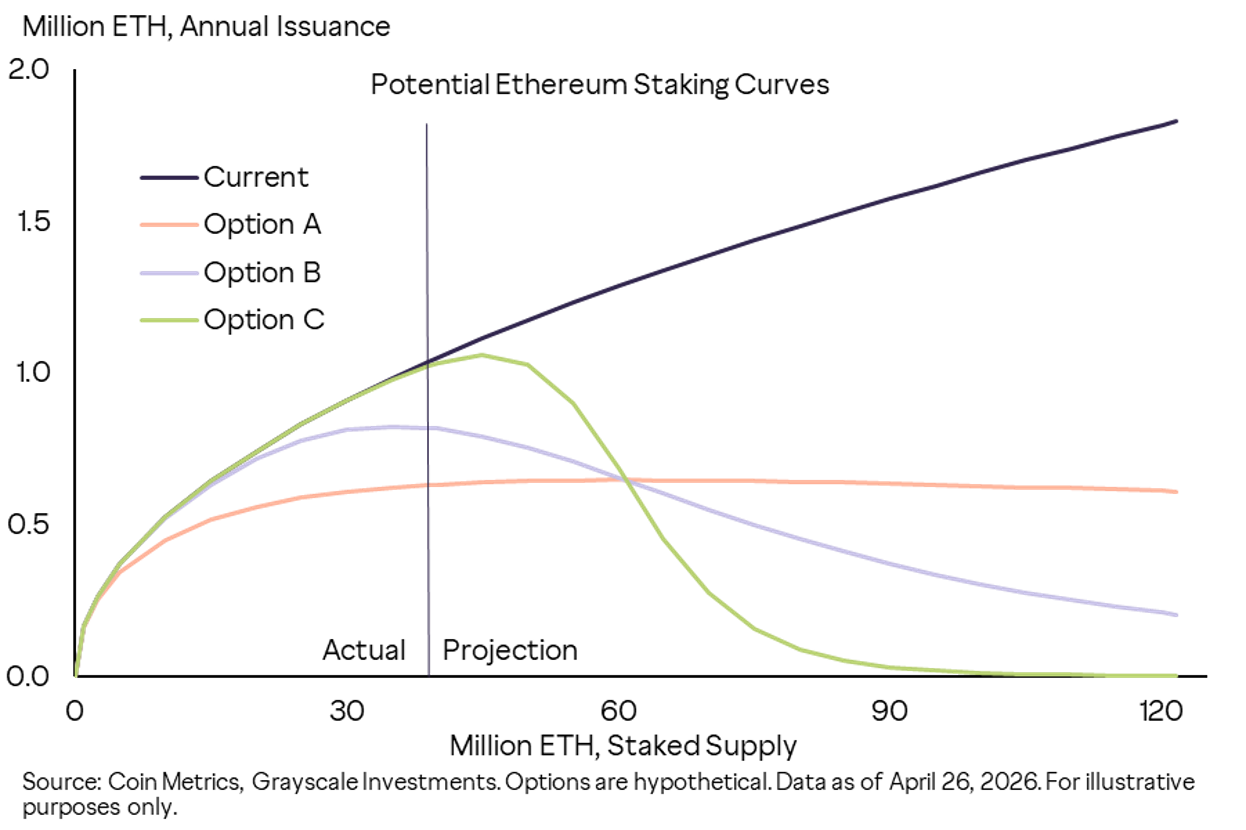
First, it creates unnecessary dilution. In other words, it raises net issuance without meaningfully increasing network security—just like a nation that overspends on defense without much benefit to national security.2 Second, high levels of stake may introduce adverse tail risks if a small number of institutions come to dominate staking activity (a possibility due to service provider network effects). One solution could be a shift to a reward model that only incentivizes staking up to a certain point (Exhibit 2).
Exhibit 2: Ethereum may consider alternative staking reward curves
In our view, such change would be positive for the market value of ETH over time. Ether is a commodity with functional utility, not a financial claim like stocks and bonds, and it should not be valued solely based on cash flows.3 Updating the staking reward model would reduce supply growth and increase ETH scarcity. This should be positive for price, in the same way that lower production would be favorable for the price of a physical commodity. Moreover, by reducing network tail risks and containing long-run inflation, the changes could increase demand for unstaked ETH as a digital store of value.
Also, it’s important to note that ETH price volatility has been a much more important driver of investment risk and return than staking rewards. For example, the current staking reward rate of ~3% equates to roughly one day of price volatility.4
Key Takeaway: Ethereum may change its staking reward model to contain long-run supply growth and reduce certain tail risks. If so, we think the shift would be positive for the price of ETH.