
August 3, 2026

Users of the Bitcoin self-custody wallet Coldcard suffered losses in recent days as hacker groups discovered and exploited a vulnerability in the wallet’s software.¹ Estimates suggest hackers have so far drained ~1,400 BTC (~$90mn) from user wallets. The incident is an unfortunate setback for Bitcoin self-custody, which is critical to the healthy functioning of the Bitcoin network in the longer-term, in our view.
However, there are several mitigating factors investors should keep in mind:
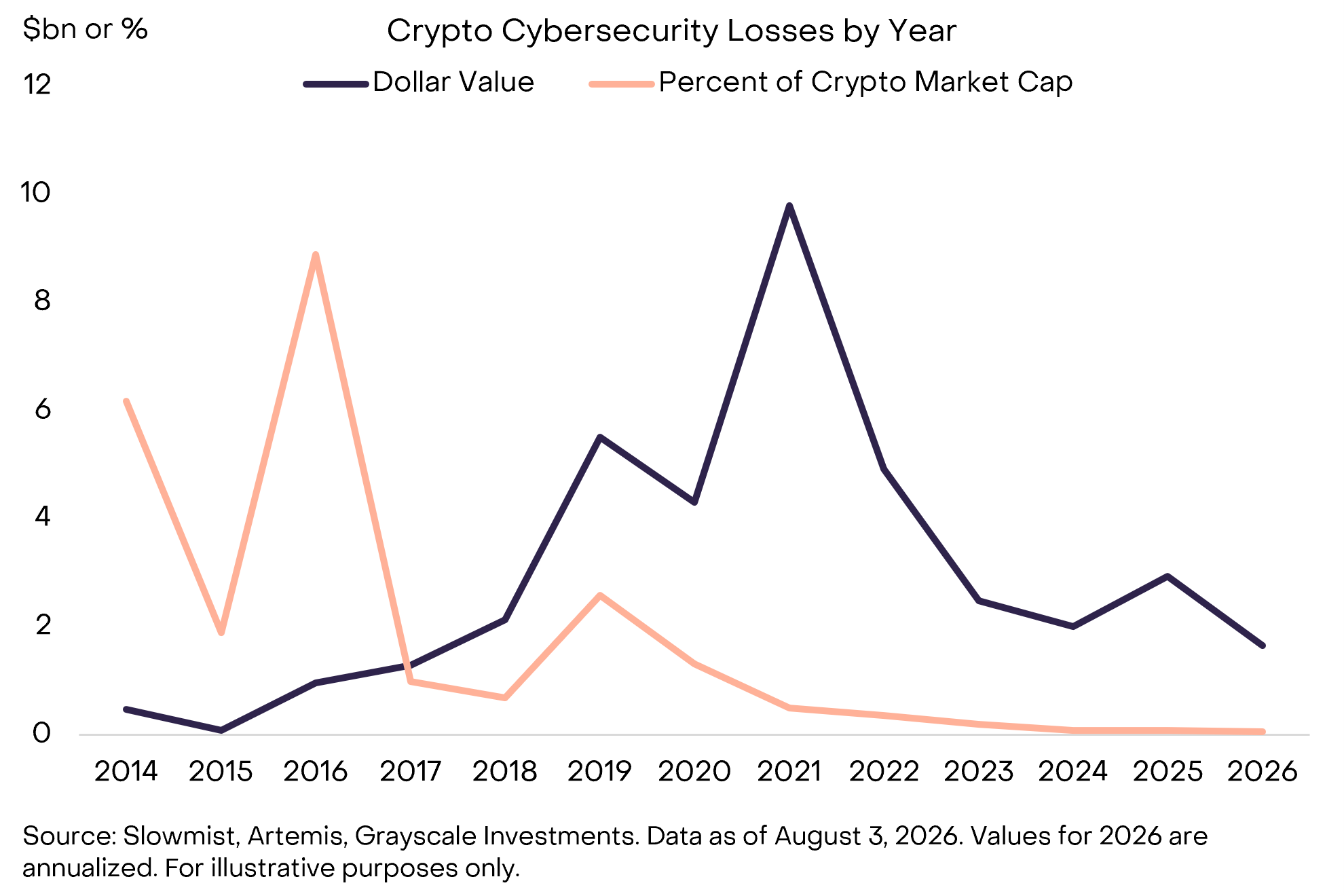
Key Takeaway: Recent security incidents are an unfortunate setback for Bitcoin self-custody, but they did not affect a) the blockchain itself, or b) any BTC held in commingled vehicles (such as ETPs and ETFs). Cybersecurity losses have also trended lower over time, and other robust custody options are available for investors.
Exhibit 1: Crypto cybersecurity losses are in long-term decline
Related
© 2026 Grayscale. All rights reserved
All data sourced from Bloomberg as of the date of publication, unless otherwise noted.
Investments in digital assets are speculative investments that involve significant risk, including a partial or total loss of invested funds. Investments in digital assets are not suitable for any investor that cannot afford loss of the entire investment.
This information should not be relied upon as research, legal, tax or investment advice, or a recommendation regarding any products, strategies, or any investment in particular. This material is strictly for illustrative, educational, or informational purposes and is subject to change. This content does not constitute an offer to sell or the solicitation of an offer to sell or buy any security in any jurisdiction where such an offer or solicitation would be illegal. There is not enough information contained in this content to make an investment decision and any information contained herein should not be used as a basis for this purpose. Readers are encouraged to seek guidance from qualified professionals.
Index returns are presented for illustrative purposes only and exclude management fees and expenses. Indexes are unmanaged, and investors cannot invest directly in an index. A basis point (bps) is one hundredth of one percent (e.g. one basis point = 0.01%).
Grayscale Operating, LLC and its affiliates, directors, officers, and employees may have interests, financial or otherwise, in the digital assets and/or securities discussed.
Certain of the statements contained herein may be statements of future expectations and other forward-looking statements that are based on Grayscale’s views and assumptions and involve known and unknown risks and uncertainties that could cause actual results, performance, or events to differ materially from those expressed or implied in such statements. In addition to statements that are forward-looking by reason of context, the words “may, will, should, could, can, expects, plans, intends, anticipates, believes, estimates, predicts, potential, projected, or continue” and similar expressions identify forward-looking statements. Grayscale assumes no obligation to update any forward-looking statements contained herein and you should not place undue reliance on such statements, which speak only as of the date hereof. Although Grayscale has taken reasonable care to ensure that the information contained herein is accurate, no representation or warranty (including liability towards third parties), expressed or implied, is made by Grayscale as to its accuracy, reliability, or completeness. You should not make any investment decisions based on these estimates and forward-looking statements.
Specific companies, issuers, platforms, or protocols are mentioned for educational purposes only and should not be deemed a recommendation to buy or sell any securities, digital assets, or other financial instruments. Any entities mentioned do not necessarily represent current or future holdings of any Grayscale products.
All content is original and has been researched and produced by Grayscale Investments Sponsors, LLC (“Grayscale”) unless otherwise stated herein. No part of this content may be reproduced in any form, or referred to in any other publication, without the express consent of Grayscale.
© 2026 Grayscale. All trademarks, service marks and/or trade names (e.g., G™, GRAYSCALE®, GRAYSCALE CRYPTO SECTORS™, and GRAYSCALE INVESTMENTS®) are owned and/or registered by Grayscale.